Freetopia

Friday, September 30, 2005

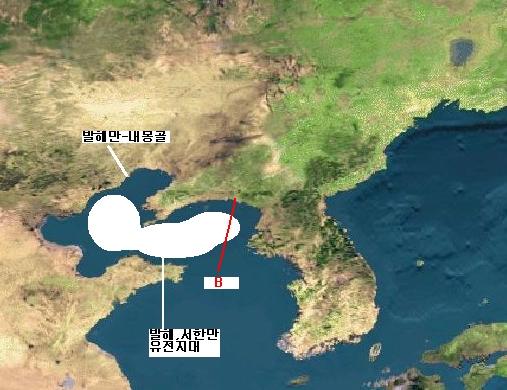
The hegemony of the world


What do you think about this map?

-------------------------------------------

Korea Cannot Be Peacefully Unified??

US will support united Korea??

----------------------------------------

Goguryeo(B.C.37~A.D.668)

- Goguryeo covered large parts of present-day Manchuria.

Thursday, September 29, 2005

Korean Mobile Phone Diverts Deadly Bullet


A Korean-made mobile phone has performed a trick folklore traditionally reserves for the Bible, saving the life of an Englishman by absorbing the bullet that was meant for him.
The BBC News and daily tabloid The Sun on Tuesday reported Darren Prior (23), the manager of a jewelry shop in West Sussex, was shot by an armed robber but survived as the bullet hit the cell phone in his breast pocket.
The reports said a masked armed robber broke into the store, took the jewelry and ran away. With Prior in hot pursuit, the man turned back and shot him twice. One bullet missed and the other killed the phone.
The projectile lodged in the battery of the LG model.
Prior said he felt the shot drilling into his chest. He thought he would find himself bleeding but was baffled to find a clean hole on his shirt.
LG Electronics is so pleased with the PR coup that it has decided to give Prior its latest third-generation mobile phone along with another home appliance of his choice such as a plasma display panel (PDP) TV or washing machine. The company said Prior would also be invited to launches of new LG products.
from www.mydaily.co.kr

S. Korea's ranking rises in global competitiveness

Korea moved up to 17th position in the global competitiveness ranking this year, achieving the biggest advancement among 117 economies, according to the World Economic Forum's annual study.

The Global Competitiveness Report 2005-2006 released yesterday showed that Asia's fourth-largest economy climbed 12 notches. It is the second time that Korea placed within the top 20 since 2003, as it continued to advance for the past three years.

The annual study touted by the WEF as a "valuable tool for shaping economic policy and guiding investment decisions," attributed Korea's sudden rise to its ability to enter a stage of economic recovery despite the strengthening won against the U.S. dollar. The stronger domestic currency threatened to dampen exports, which have been the country's main economic driver amid sluggish consumption.


Finland retained the No. 1 spot for the third consecutive year. The United States has remained second since Finland replaced the world's-largest economy in the 2003-2004 report.

The remainder of the top 10 were Sweden, Denmark, Taiwan, Singapore, Iceland, Switzerland, Norway and Australia.

In Asia, Taiwan continued to be the most competitive, placing fifth, followed by Singapore at sixth place. The WEF report described them as "Asia's two dragons."
Japan, the world's second-largest economy, ranked 12th, sliding three notches.

The WEF report has been published for the past 26 years, serving as an authoritative guide to the competitive condition of economies worldwide.

from The Korea Herald

Wednesday, September 28, 2005

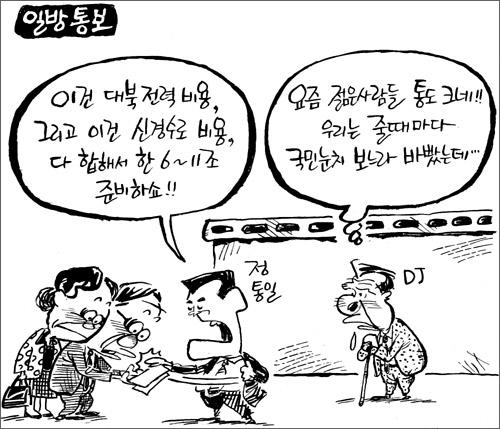
These Young Spendthrifts...


As Unification Minister Chung Dong-young tells lawmakers to ready W6-11 trillion to provide energy aid to North Korea, former president Kim Dae-jung looks on and says, "Boy, young people these days are free-handed. When we gave to the North, we spent most of our time watching the public mood."

Luxury Customers Getting Younger

The main customers of luxury brands are getting younger, with shoppers in their 20s and 30s outnumbering those in their 40s and 50s at high-end department stores like Lotte’s Avenuel and Galleria. The industry targets them as “young luxury customers,” but there are fears that that will aggravate an unhealthy consumption habit since few of them are economically independent.


People in their 20s and 30s accounted for 48 percent of customers who bought luxury goods at Avenuel in July, 10 percentage points more than those in their 40s and 50s. The proportion of 20-somethings has been going up by a percentage point a month from 12.3 percent in April to 16.9 percent in July. The same goes for Galleria Department Store with its longer history of selling luxury goods. People in their 20s and 30s constituted 57.1 percent of the store’s luxury customers in July.


Ha Seong-dong of Lotte Department Store says the young, unlike their parents, have grown up surrounded by luxury goods, and to them designer brands are simply a means to express themselves rather than an unnecessary indulgence.


Department stores are competing to woo these young customers. Galleria says it is displaying more trendy goods and increasing the number of multi-shops. It is also strengthening marketing strategies for young luxury customers such as events for soon-to-be-married couples. It has also become a home to high-end restaurants and cultural spaces to fit the taste of the new customers.


Yet many of them do not earn the money they spend on luxury goods. Students or jobless people account for over 10 percent of 20-something customers of luxury departments.

from chosun

Monday, September 26, 2005

Letter from China Written by a Defector

“Please get rid of the rotten Kim Jong Il regime”

Last March, Citizens' Coalition for Human Rights of Abductees and North Korean Refugees (CHNK) received a letter. It was a letter requesting for rescue written by a North Korean defector.

The writer letter is Ms. Park, who attempted defection to South Korea through Mongolia in December 2003, but got arrested by the Chinese police and repatriated to North Korea. He was released by many injuries on his body from torture. He attempted defection again and arrived in China, but had to have both of his legs amputated.

With the contribution by the CHNK. The DailyNK releases the letter in full text to the readers. Ms. Park is currently making a stay in Thailand, waiting to come to South Korea.

Following is the letter in full text.

I want to go to South Korea!

Dear Respected Misters! How do you do?I am Park **, a defector from ** City of South Hamkyung province.
I defected to China and lived Jangchun (China) with my son, but having been treated like pebbles on the streets, I realized where I must go is South Korea, where my freedom and human rights will are secured. To realized my dream, I left for Manzhouli(a name of a place, China) but instead of paradise, I was taken to North Korea, arrested by Chinese police and forcefully repatriate, and I returned to China handicapped.

December 12, 2003, everyone was excited for the coming Christmas, and I, with faith in God that I will be able to make it to South Korea, left alone leaving my son in Changchun with the help of the cook of the restaurant I was working for. Once I made up my mind to defect, there was nothing I was afraid of. However, I was arrested on December 20 in Nei Monggol by Chinese police, and was sent back to North Korea. First I was sent to Jipkyulso in Chungjin City, then to Forced Labor Concentration Camp located in Shinpo City in South Hamkyung province. I cannot write down all the sufferings I have experienced in my homeland with few words or in few pages.

When I first arrived in North Korea, my feet were not that bad, they were only a little swollen. However, in the cold prison cell of Onsung Security Department the next January, they pierced my feet with oxidized metal, and I was beat up and kicked with boots that my eyes bled.

I was beat up like that everyday, and my feed were chained that feet were metal poisoned and became more swollen. From the parts where they were pieced came out blood and puss, and started to rot.

I suffered of pain and cried every night, and they hit my feel even more saying that my feet should rot up to my knees so I will never attempt to defect to South Korea again. In such fearful pain, I promised myself that if I cannot make it to South Korea walking on my feel, then I will make to by my elbow crawling and testify the crimes of the Kim Jong Il regime. That determination kept me alive until today.

Looking at my rotting feet with puss gushing out, I prayed again and again for God to bring an end to the Kim Jong Il, a government as rot as my feet, under which the people die away everyday and where no human dignity could be found.

With time I was bruised all over my body, even the white parts of my eye balls became blue, and I looked like a monster, not a human being. But they still beat me and kicked me and said that they are letting me live.

They were right though. If it were no for my rotten feet, I would not have made out. After a month, they showed me a written page of which they wrote testifying that I have attempted to defect to China and was arrested by the Chinese police.

I was dumbfounded.

Then they released me looking at my feet that have turned black by then, so I can be treated. I looked at my feet, which gave me so much pain, and was happy because they let me live. Misters!

Does this make sense anywhere in the world? Is this what a normal person can imagine? The screams and moans that came out of my mouth for pain… I do not even want to remember ever again. My feet that gave me so much pain are gone now so I no longer can stand.

That scream and moaning were not only mine but were of out parents and bothers, and also of that Kim Jong Il regime that is so rot that it can no longer stand alone.

After that, with the least treatment I could get, pain was reduced. Despite my parents’ and sister’s tears, I left them with canes, I fell on ground because of hunger and I crawled because I could not longer walk, but I made it do China. My son and my friends cried when they saw me, but I did not cry because I escaped from the hell and will find a way to South Korea

However, now, seven months here, it seems like my dream to go to South Korea is so far in distance. Instead, I suffer of threat of arrest by Chinese police everyday, and the fear drives me nearly crazy.

As if it were my business, I look at the clothes everyday and search for the land I want to be in, but it makes more suffer even more that I cannot even imagine the place.

Respected misters! Help me. Make my wish to go to that place come true. I ask you with all and all my heart. Please pray for me so the fair God will forgive all my sins and guide me to South Korea.I will wait for your reply with hope.

March 25, 2005
Written by Park **

from donga
----------------------------------------
Stills 'Show N.Korean Soldiers Abusing Woman' < Link >

Global Competitiveness Report 2004-2005

Country Rankings 2004-2005
1. Finland

2. USA

3. Sweden

4. Taiwan

5. Denmark

>>Full rankings
-------------------------------------

Global Information Technology Report 2004-2005 < Link >

Country Rankings
1. Singapore

2. Iceland

3. Finland

4. Denmark

5. US

>>Ranking in full

Seoul to spend 8.6 tln won in expanding social safety net

SEOUL, Sept. 26 (Yonhap)
The government has decided to spend a total of 8.6 trillion won (US$8.3 billion) over the next four years to strengthen the country's social safety net, officials said Monday.

The decision was made at a government-ruling party meeting earlier in the day, where the sides also resolved to ease requirements that make citizens eligible for state subsidies.

To that end, the government will raise the poverty line to add 120,000 more to the list of recipients of government aid. Currently, 1.49 million people on the list.In an effort to reduce the income gap between the rich and poor, the Earned Income Tax Credit (EITC) system, a refundable tax credit for low-income workers outside the social safety net, will be introduced in 2007.

The EITC system is designed to help people in the low-income groups with subsidies and tax benefits .

The government also decided to expand medical subsidies. Originally given to households with incomes below the minimum living cost of 1.13 million won a month, households in the bracket above will also be included by 2009.

To cope with the problems of a rapidly aging society, the government will introduce nurses to low-income families who support their elderly with serious diseases like Alzheimer's in July 2008.As many as 110 more sanitariums will also be constructed by that deadline to help the elderly.

Saturday, September 24, 2005

Recall the conferences

The Web 2.0 Conference is of, for and about the leading figures and companies driving innovation in the Internet economy. The conference will debut with the theme of "The Web as Platform," exploring how the Web has developed into a robust platform for innovation across many media and devices - from mobile to television, telephone to search. < Link >

The Web 2.0 conference 2004

Tim O'Reilly and John Battelle on the big themes of the conference:
-The web is a development environment.
-Websites are now software components that you can call as services.
-PC application stack was Intel-Others-Windows, with third party applications to lock in at the top.
-Web application stack is NetworkSolutions - OpenSource/Browsers - BigGuysLikeAmazonAndMapquestAndGoogle, with network effects to lock in at the top.
-Customers build businesses -- tons of people are putting content on the Internet to help eBay, Google, Blogging, Amazon, Flickr, etc.
-Microsoft won the browser war but saw no financial gains from the win. All the value has migrated to the applications.
-We're seeing the end of the software upgrade cycle, because Web applications are always up-to-date.
-"The Power of the Tail" means you can have a lot of small players that all survive. Google AdSense takes advantage of the tail. < More >

-------------------------------------------------------------
Supernova 2005
MeshForum 2005
ETech 2005
OSBC2005
Software 2005
SDForum
SofTECH

Friday, September 23, 2005

Contemporary Philosophy

Critical Theory and
Postmodern Thought
Resources
Readings

Theodor Adorno
Louis Althusser
Roland Barthes
Michael Bakhtin
Jean Baudrillard
Walter Benjamin
Maurice Blanchot
Kenneth Burke
Jacques Derrida
Gilles Deleuze
Terry Eagleton
Stanley Fish
Michel Foucault
Frankfurt School
Hans-George Gadamer
Anthony Giddens
Antonio Gramsci
Felix Guattari
Jurgen Habermas
Donna Haraway
Martin Heidegger
Agnes Heller
Max Horkheimer
Edmund Husserl
Fredric Jameson
Julia Kristeva
Jacques Lacan
Bruno Latour
Jean Francois Lyotard
Georg Lukács
Paul de Man
Herbert Marcuse
Karl Marx
Maurice Merleau-Ponty
Richard Rorty
Jean-Paul Sartre
Edward Said
Charles Taylor
Paul Virilio
Ludwig Wittgenstein
Related pages:Semiotics Critical Pedagogy Qualitative Research Constructivism Theory of Technology Corollary Sites

BasicsWhat is Postmodernism?
Postmodernism (Wikipedia)
What is Postmodernism? (Mary Klages)
What is Postmodernism? (Jay Lemke)
etymology: post modern (John Unsworth)
Basic terms and definitions (Tim Spurgin)
Postmodern, Postmodernism, Postmodernity (Martin Irvine)
Postmodernism, Pedagogy, and Philosophy of Education (Clive Beck)
Postmodernism and its Critics (Shannon Weiss & Karla Wesley) What is Critical Theory?
Critcal Theory (James Bohman, Stanford Encyclopedia of Philosophy) archive
Critical Theory (Wikipedia)
What is Critical Theory? (University College Chichester)
What is Critical Theory? (Bob Nowlan)
Introductory Guide to Critical Theory (Dino Felluga)
Critical Theory and the Limits of Sociological Positivism (R. George Kirkpatrick) mirror
Resources

Groden and Kreiswirth (eds) The Johns Hopkins Guide to Literary Theory & Criticism Online
Cultural Studies and Critical Theory (Geoffrey Sauer)
Critical Pedagogy
Logos A quarterly journal of modern culture, politics and society.
Essays on the Philosophy of Technology an extensive collection of essays in contemporary philosophy (Frank Edler, Metropolitan Community College Omaha, Nebraska)
CTheory (an international journal of theory, technology, and culture)
Critical Inquiry (University of Chicago)
Postmodern Culture (University of Virginia, Vassar, JHU Press)
Theory.org (David Gauntlett)
Contretemps (Univ of Sydney)
University of Minnesota Press Literary and Critical Theory
Guide to Philosophy on the Internet (Peter Suber)
Dictionary of the Philosophy of Mind (Chris Eliasmith)
Dear Habermas, A Journal of Postmodern Thought (Jeanne Curran)
Continental Philosophy (Bruce Janz)
French Nietzsches: Links (Duncan Large)
Irreverence Anti-essentialist perspectives (Fayaz Chagani)
Univ of Chicago Conference: After Postmodernism online papers Louis Althusser
Althusser profile (Mary Klages)
Althusser profile (Andy Blunden)
Althusser profile (Daniel Chandler)
Althusser profile (Garth Kemerling)
Louis Althusser Internet Archive (Marxists.org)
Falluga Louis Althusser on Ideology
Taccheri Louis Althusser's " Ideology and Ideological State Apparatuses"
Jean Baudrillard
Baudrillard profile (Wikipedia)
Baudrillard profile (Byron Hawk)
Baudriallard profile and annotated bibliography (Ben Attias)
Felluga Jean Baudrillard on Postmodernity
Falluga Jean Baudrillard on Simulation
The "ecstasy" of Jean Baudrillard (Richard Vine)
Baudrillard Home Page (European Graduate School)
Baudrillard on the Web (Alan Taylor)
Baudrillard Home Page (European Graduate School)
Kellner (1989) Baudrillard: A New McLuhan?
Boundaries and Borderlines: Reflections on Jean Baudrillard and Critical Theory (Doug Kellner)
Simulacra and Simulations from Jean Baudrillard, Selected Writings, ed. Mark Poster (Stanford; Stanford University Press, 1988).
book announcement (FrontList Books)
summary (Paul Smethurst)
short reviews (Stanford University Press)
Norris (2004) Hannah Arendt and Jean Baudrillard: Pedagogy in the Consumer Society
Baudrillard Links (Richard Pope)
Maurice Blanchot
Blanchot obituary (Douglas Johnson)
Michelmore The Absent Voice: on the writings of Maurice Blanchot
Barker (1995) Nietzsche/Derrida, Blanchot/Beckett: Fragmentary Progressions of the Unnamable (PMC)
Lier (2002) The City and the Stars: Politics and Alterity in Heidegger, Levinas and Blanchot
Lier (2001) Our Responsibility: Blanchot's Communism pdf document
Jacques Derrida
Remembering Jacques Derrida July 15, 1930 - October 8, 2004
London Daily Telegraph
Expatica
BBC News
the Jerusalem Post
Sophia News Agency
Voice of America
Channel News - Asia
Cleveland Plain Dealer
Times of London
FrontPageMag.com
U.C. Irvine News
the Times of India
The Australian
Cornell Daily Sun
Christian Science Monitor
Lewis and Klein
Derrida profile (Wikipedia)
Derrida profile (Garth Kemerling)
Derrida profile (Ron Turner quoting Microsoft Encarta)
Derrida profile (Jahsonic.com)
Jacques Derrida (Stanford Humanities Symposia)
Derrida Interview a discussion about 'law' with Michael Rosenfeld
Derrida and Deconstruction (David Arnason)
Derrida Timeline (Tim Spurgin)
Derrida - the film by Kirby Dick and Amy Ziering Kofman
review by Elvis Mitchell
review by Holly Wills
production notes IAPL
review by Tim Merrill
review by V.A. Musseto
review by Edward Guthmann
review by Jeff Vorndam
review by Marjorie Baumgarten
Kofman and Dick interviewby Michelle Handelman
Structuralism/Poststructuralism (Mary Klages)
Of Grammatology
Linquistics and Grammatology (from Of Grammatology, courtesy Marxists.org)
Derrida (1994) What is Ideology? (Marxists.org)
Structure, Sign, and Play in the Discourse of the Human Sciences (a reading guide by Mary Klages)
On Cosmopolitanism and Forgiveness (2001) review (by David Reinhart)
Egéa-Kuehne (1996) Neutrality in Education And Derrida's Call for "Double Duty"
Olson (1990) Jacques Derrida on Rhetoric and Composition: A Conversation
Derrida Bibliography (Eddie Yeghiayan)
Derrida Bibliography (Peter Krapp)
Deleuze and Guattari
An Introduction to Deleuze and Guattari (David Arnason)
Deleuze and Guattri on the Web (Alan Taylor)
Deleuze and Guattari on the Web (Charles Stivale)
L'Abécédaire (Summary by Charles Stivale)
The Movement-Image (Book announcement)
Terry Eagleton
Literary Theory, an introduction
Book Announcement (Univ of Minnesota Press)
Illusions of Postmodernism
Calder (1997) Postmodernism and its Ironies
Literary Theory 2nd edition (Book announcement)
Eagleton review of Conrad, Modern Times, Modern Places
Stanley Fish
Fish profile (Reed Way Dasenbrock)
Stanley Fish Resource Center (Kyösti Niemelä)
Michel Foucault
Foucault profile (Wikipedia)
Foucault profile (Mark Poster)
Foucault profile (David Vessey and Stephen Watson)
Foucault profile (Ron Turner)
Foucault profile (Garth Kemerling)
Foucault profile (Sebastian Foti)
Foucault profile and readings (Generation Online)
Foucault (David Gauntlett)
Foucault Home Page (Ben Attias)
Foucault Resources (Clare O'Farrell)
Theatrum Philosophicum (1970) (Courtesy, Generation Online)
Archeology of Knowledge (1969) (courtesy, Marxists.org) part 2
Falluga (2003) Foucault on Gender and Sex
The History of Sexuality
review (by Dale Lakevold)
Thorp (1990) The Social Construction of Homosexuality
Mark Poster (1984) Foucault, Marxism and History Mode of Production Versus Mode of Information
Miller (1994) Foucault's Virtual Passion
Author Function
Covaleskie (1993) Power Goes to School: Teachers, students, and discipline
Palermo (1994) I'm not Lying, This is not a Pipe:Foucault and Magritte on the art of Critical Pedagogy
Mayo (1997) Foucauldian Cautions on the Subject and the Educative Implications of Contingent Identity
Spurgin Reader's Guide to 'What is an Author'
the Frankfurt School
Profile (Wikipedia)
Profile (Daniel Chandler)
Profile (Garth Kemerling)
Profile (Henk Tuten)
Profile (Jahsonic.com)
Illuminations (Doug Kellner and Brian Hawk)
Kellner (1997) The Frankfurt School and British Cultural Studies: The Missed Articulation
Kellner Critical Theory and the Crisis of Social Theory
Kellner Critical Theory Today: Revisiting the Classics
O Ruairc (2003) The Politics of Despair: The Critical Theory of the Frankfurt School
Cowen (2003) The Significance of the Frankfurt School and Critical Theory
Bronner Dialectics at a Standstill
Wiggershaus (1994) The Frankfurt School. Its History, Theories, and Political Significance (review by Douglas Kellner)
Dialectiques (P. Deramaix)
Theodor Adorno
Adorno profile (Wikipedia)
Adorno profile (Michael Jones)
Adorno profile (Garth Kemerling)
Adorno profile (Jahsonic.com)
In perspective: Theodor Adorno (Dave Harker)
Adorno: Aesthetic Theory (Book announcement)
Adorno Why Still Philosophy (exerpts)
Cook (1996) The Culture Industry Revisited (Review by Doug Kellner)
Bronner Dialectics at a Standstill: A Methodological Inquiry Into the Philosophy of Theodor W. Adorno
Adorno Study Guide (Ralph Dumain)
The Culture Industry: Enlightenment as Mass Deception (Adorno and Horkheimer, 1944)
Marxists.org
Adorno Study Guide (Ralph Dumain)
Adorno corollary sources (ErraticImpact.com)
Walter Benjamin
Benjamin profile (Wikipedia)
Benjamin profile (Encyclopedia of Marxism)
,a href=http://www.jahsonic.com/WalterBenjamin.html>Benjamin profile (Jahsonic.com)
The Walter Benjamin Research Syndicate
Walter Benjamin (erraticimpact.com)
Lloyd Spencer lectures on Benjamin
Bronner (1991) Reclaiming the Fragments: On the Messianic Materialism of Walter Benjamin
Berman Angel in the City (reviews of Brodersen, Bullock & Jennings, and Parini)
Max Horkheimer
Horkheimer profile (Wikipedia)
Horkheimer profile (Jahsonic.com)
Adorno and Horkheimer (1944) The Culture Industry: Enlightenment as Mass Deception (courtesy Marxists.org)
Materialism and Metaphysics (exerpts)
Herbert Marcuse
Herbert Marcuse Homepage (Harold Marcuse)
Marcuse profile (Wikipedia)
Marcuse profile (Douglas Kellner) mirror
Marcuse profile (Douglas Kellner)
Marcuse profile (Garth Kemerling)
Marcuse profile (Tad Beckman)
Marcuse profile (Lloyd Spencer)
Marcuse profile (Anne Shaw)
Marcuse profile (Bob Trubshaw) mirror mirror mirror
Marcuse bio (Harold Marcuse)
Marcuse bio (Douglas Kellner) Marcuse Archive (Marxists.org)
Marcuse Archive (Christian Fuchs)
Marcuse Bibliographie (P. Deraimaix)
One-Dimensional Man
One-Dimensional Man: Studies in the Ideology of Advanced Industrial Society (1964) (Full text courtesy, Christian Fuchs)
One Dimensional Thought (courtesy, Marxists.org) mirror
Kellner From 1984 to One-Dimensional Man: Critical Reflections on Orwell and Marcuse
Aggressiveness in Advanced Industrial Society (1967) from Negations: Essays in Critical Theory Beacon Press mirror
From Philosophy to Social Theory (1941) (Courtesy Andy Blunden)
Hegel's First System (Courtesy Andy Blunden, Marxists.org)
Eros and Civilization: A Philosophical Inquiry into Freud (1969)
review by Robert Young
Reason and Revolution (1941)
Feenberg (1996) Marcuse or Habermas: two critiques of technology
Feenberg (1992) Marcuse: Obstinacy as a Theoretical Virtue
Kellner (1982) Marcuse, Liberation, and Radical Ecology
Kellner (1998) Technology, War and Fascism, Collected Papers of Herbert Marcuse review (by Marsha Hewitt)
Langston (1968) Herbert Marcuse and Marxism
Fucks On the Topicality of Selected Aspects of Herbert Marcuse's Works
Buick Marcuse: professor behind 1960s rebellion
Georg Lukács
Lukács profile (Pegasos)
Lukács profile (Marxists.org)
Lukács profile (Akamac)
Lukács profile (Garth Kemerling)
Lukács Archive (Marxists.org)
Blanc (1977) Georg Lukács: The Antinomies of Melancholy
Feenberg (1981) Lukács, Marx and the Sources of Critical Theory (Preface and TOC)
Sharp (1999) We are all Kantian
Hans-George Gadamer
Gadamer profile (Stanford Encyclopedia of Philosophy)
Gadamer profile (Wikipedia)
Gadamer profile (the Literary Encyclopedia)
Gadamer biography (European Graduate School)
Gadamer obituary (Washington Post / Reuters)
Gadamer obituary (Zouhair Ghazzal)
Gadamer home page (Etsuro Makita)
Arthos (1993) To Be Alive When Something Happens: Retrieving Dilthey's Erlebnis
Bilen (1995) The Historicity of Understanding and The Problem of Relativism in Gadamer.s Philosophical Hermeneutics
Blacker (1993) Education as the Normative Dimension of Philosophical Hermeneutics
Grondin (2004) Gadamer's Hope
Hogan (2000) Gadamer and the Philosophy of Education
Holub (1997) Hermeneutics
Vessey (2003) Gadamer's Theory of Time Consciousness
Anthony Giddens
Giddens profile (Edge Foundation)
Intro to Giddens (David Gauntlett)
Giddens on Globalization (BBC News)
Antonio Gramsci
Gramsci profile (Monica Stillo and David Gauntlett)
Gramsci profile (Barry Burke and Mark Smith)
Gramsci profile (Monica Stillo)
Gramsci profile (Garth Kemerling)
An Introduction to Gramsci's Life and Thought (Frank Rosengaden)
Gramsci and Hegemony (Daniel Chandler)
International Gramsci Society
Gramsci Internet Archive (Marxists.org)
The Study of Philosophy (from the Prison Notebooks)
The Organisation of Education and Culture (exerpted by Carl Gutierrez-Jones)
Brandist (1995) Bakhtin, Gramsci and the Semiotics of Hegemony
Martin (2002) Antonio Gramsci: Critical Assessments of Leading Political Philosophers (review by Adam David Morton)
On Intellectuals (Gramsci quote from MarxMail.org)
Jurgen Habermas
Habermas profile (Wikipedia)
Habermas profile (Steve Robinson)
Habermas profile (Mitchell Stephens)
Habermas profile (Jahsonic.com)
Habermas (1991) Middle of Nowhere: Destruction of Reason
Habermas (1968) The Idea of the Theory of Knowledge as Social Theory
Grady and Wells Toward A Rhetoric of Intersubjectivity: Introducing Jurgen Habermas
Ó Baoill (2000) Slashdot and the Public Sphere
Dahlberg (2000) Extending the Public Sphere through cyberspace: the case of Minnesota E-democracy
Poster (1995) CyberDemocracy: Internet and the Public Sphere
Donna Haraway
Haraway profile and bibliography (Elisa Kay Sparks)
Haraway Home Page (Univ of California, Santa Cruz)
Hyperlink to Donna Haraway (Toyofuku, Tsuyoshi)
Modest_Witness@Second_Millennium. FemaleMan©_Meets_OncoMouse™. Feminism and Technoscience (1996)
Exerpts from The Cyborg Manifesto
An Ironic Dream of a Common Language for Women in the Integrated Circuit
The Promises of Monsters: A Regenerative Politics for Inappropriate/d Others (1992)
Haraway () The Promises of Monsters: A Regenerative Politics for Inappropriate/d Others mirror
Writing, Literacy and Technology: Toward a Cyborg Writing (Gary Olson interview with Donna Haraway)
Art and Science in Chaos: Contesting Readings of Scientific Visualisation (Richard Wright)
Carubia (1998) Haraway on the Map
Edmund Husserl
Husserl profile (Wikipedia)
Husserl Profile Internet Encyclopedia of Philosophy
the Origin of the Modern Opposition between Physicalistic Objectivism and Transcendental Subjectivism. (1937) (courtesy Marxists.org)
The Way into Phenomenological Transcendental Philosophy from Psychology (1937) (courtesy Marxists.org)
Martin Heidegger
Heidegger profile (Wikipedia)
Heidegger Profile (Ron Turner)
Heidegger Profile (Garth Kemerling)
Heidegger Profile (Samuel Ebersole)
Heidegger Profile (Bedford St. Martins press)
The Basic Problems of Phenomenology (1927) (Courtesy, Marxists.org)
Existence and Being (1949) (Courtesy, Marxists.org)
Dreyfus Being and Power: Heidegger and Foucault
Dreyfus Heidegger and Foucault on the Subject, Agency and Practices
Dreyfus Highway Bridges and Feasts: Heidegger and Borgmann on How to Affirm Technology
Çüçen (1998) Heidegger's Reading of Descartes' Dualism: The Relation of Subject and Object
Ereignis a comprehensive Heidegger site by Pete Ferreira
Some Writings of Heidegger by Jud Evans
Heidegger Athenaeum (A site critical of Heidegger, by Jud Evans)
Hornsby (2002) What Heidegger Means by Being-in-the-World
Ereignis Heidegger and Technology Links
Gorner Heidegger, Phenomenology and the Essence of Technology
XuanmengHeidegger on Technology, Alienation and Destiny
Vessey Martin Heidegger: The Question Concerning Technology
See Theory of Technology
Agnes Heller
Heller Curriculum Vita
Heller Interview (Csaba Polony)
Tormey Agnes Heller Socialism, Autonomy and the Postmodern
Beyond Justice (1987) (Courtesy, Marxists.org)
Fredric Jameson
Jameson profile (Doug Kellner)
Postmodernism, or, the Cultural Logic of Late Capitalism (1991) (courtesy Marxists.org)
reviews (Stanford Presidential Lectures and Symposia in the Humanities and Arts)
exerpts (Stanford Presidential Lectures and Symposia in the Humanities and Arts)
Seeds of Time
excerpt (Primitivism.com)
The Prison-House of Language: A Critical Account of Structuralism and Russian Formalism
exerpts (Stanford Presidential Lectures and Symposia in the Humanities and Arts)
The Political Unconscious (1981)
exerpts (Stanford Presidential Lectures and Symposia in the Humanities and Arts)
Marxism and Form: Twentieth-Century Dialectical Theories of Literature
exerpts (Stanford Presidential Lectures and Symposia in the Humanities and Arts)
Late Marxism: Adorno or the Persistence of the Dialectic
Geopolitical Aesthetic: Cinema and space in the world system
Falluga Fredric Jameson on Ideology
Homer (1994) Fredric Jameson and the Limits of Postmodern Theory
Jameson Bibliography Eddie Yeghiayan
Longer Texts on Jameson (Wellek Library, UC Irvine)
Julia Kristeva
Kristeva profile (Wikipedia) mirror
Kristeva profile (Kelly Oliver)
Kristeva profile (Alice Kelsey)
Kristeva profile (Columbia Encyclopedia)
Kristeva profile (Dino Felluga)
Lechte (1990) Julia Kristeva
review (by Claire O'Farrell)
In the name of the Father, the Son . . . and the Woman? (Kristeva web resource by Lynn Chrenka)
Kristeva Bibliography (Hélène Volat)
Powers of Horror (1982)
review (by Trudy Mercer)
Kelly (ed) Ethics, Politics, and Difference in Julia Kristeva.s Writing
Kristeva (1994) On Yury Lotman
Oliver (1998) Kristeva and Feminism
Ziarek (1995) The Uncanny Style of Kristeva's Critique of Nationalism
Jean-François Lyotard
Lyotard Profile (Garth Kemerling)
Lyotard profile (FOLDOP: Free On Line Dictionary Of Philosophy)
Lyotard Biography (Ashley Woodward)
Lyotard Home Page (European Graduate School)
Jean-François Lyotard: A Bibliography (Eddie Yeghiayan)
Books about Lyotard(Eddie Yeghiayan)
The Postmodern Condition: A Report on Knowledge (1979) (ch 1-5, courtesy, Marxists.org) mirror (Athenaeum Reading Room) mirror (Rathbone)
Postmodern Fables (book announcement)
Libidinal economy
precis (FrontList Books)
book announcement (Indiana Univ Press)
Libidinal Philosophy (Ashley Woodward)
Economy (David Corker)
Roberts 1998) Rereading Lyotard: Knowledge, Commodification and Higher Education
Karl Marx
Marxism (Wikipedia)
Marx profile (Wikipedia)
Marx and Engles profile (James Winders)
Marx and Engels Internet Archive (Marxists.org)
Karl Marx and Informal Education (Barry Burke)
Marxist Media Theory (Daniel Chandler)
Marx on Ideology (Dino Falluga)
Gouldner The Two Marxs: Contradictions and Anomalies in the Development of Theory
Mark Poster Existential Marxism in Postwar France
Mary Klages Marxism and Ideology
Karl Marx's Sociology (Frank Elwell)
Paul de Man
de Man profile (Cynthia Chase)
de Man profile (Bedford/ St. Martin's Publishing)
Aesthetic Ideology (Book announcement)
Texts by Paul de Man Eddie Yeghiayan
Maurice Merleau-Ponty
Merleau-Ponty profile (Wikipedia)
Merleau-Ponty profile (Columbia Encyclopedia)
Merleau-Ponty: Le visible et l'invisible (Claude Lefort, 1988)
The Merleau-Ponty Circle (Binghamton University)
Dreyfus (1998) Intelligence Without Representation: Merleau-Ponty's Critique of Mental Representation: The Relevance of Phenomenology to Scientific Explanation
Marjorie O'Loughlin (1995) Intelligent Bodies and Ecological Subjectivities: Merleau-Ponty's Corrective to Postmodernism's "Subjects" of Education
reply by Shari Popen
Richard Rorty
Rorty profile (Bjørn Ramberg, Stanford Encyclopedia of Philosophy) mirror mirror
Rorty profile (Richard Shusterman)
Rorty Home Page (Stanford)
An Interview with Richard Rorty by Joshua Knobe
Consequences of Pragmatism (1982) (Courtesy, Marxists.org)
Phony Science Wars (1999) (the Atlantic)
Feminism, Ideology, and Deconstruction: a Pragmatist View
Truth and Progress (1998)
review (by Michael Albert)
Achieving Our Country: Leftist Thought in Twentieth-Century America
Scott Stossel interviews Richard Rorty (the Atlantic, April 1988)
Douglass (1977) Political Liberalism and Universalism: Problems in the Theories of David Gauthier and Richard Rorty
Haber Rorty on Feminism
Rockwell Critique of Rorty's analysis of Modern Epistemology
Rothfork (1994) Postmodern Ethics: Richard Rorty & Michael Polanyi
Smuts American Philosophy/Emerson & Rorty
Collins (1993) Truth as a Communicatitive Virtue in a Postmodern Age: From Dewey to Rorty
Coombs (1997) Rorty, Critical Thought, and Philosophy of Education
Okshevsky (1977) Richard Rorty on the Power of Philosophical Reflection and the Pragmatist Conception of Critical Thinking: A Redescription
Reich (1996) The Paradoxes of Education in Rorty's Liberal Utopia
Pendlebury (1996) Response to Reich
Jean-Paul Sartre
Sartre profile (Wikipedia)
Sartre profile (Garth Kemerling)
Sartre profile (Steven Ungar)
Edward Said
Remembering Edward Said November 1935 - September 2003
Reuters
Boston Globe
Guardian (London)
London Daily Telegraph
Democracy Now!
Michael Wood
Sherri Muzher
Saveed Ahmad
The Economist
Partners for Peace
Ramzy Baroud
Mustafa Barghouti
Australian Broadcasting
Nigel Parry
Said profile (Bedford/ St. Martin's Publishing)
Edward W. Said Bibliography (Eddie Yeghiayan)
Reviews of Edward Said's Works (Eddie Yeghiayan)
Orientalism
Review by Danielle Sered
summary by Kumiko Sato
Reviews in print Eddie Yeghiayan
Peace and its Discontents: Essays on Palestine in the Middle East Peace Process
review by Matthew Dallek
review by Eric Rouleau
Miller (1991) Privacy and Pleasure: Edward Said on Music
Miracle of Oslow response by Ronald Bleier
Bahri (1996) Introduction to Postcolonial Studies
Charles Taylor
Taylor on the Web (Scott Moore)
Ethics of Authenticity
Review by Michael Novak
Malaise of Modernity Review by Russell McNeil

Readings

Banerjee (1995) Alienation, Power, and Gender in Sociological Theory: A Study of Marx, Foucault, and Feminism
Beck (1993) Postmodernism, pedagogy, and Philosophy of Education
Best and Kellner (1991) Postmodern Theory: Critical Interrogations (review by Dick Richter)
Bonner (1993) Of Critical Theory and Its Theorists
Burbules (1995) Postmodern Doubt and Philosophy of Education
Burbules (1997) Aporia: Webs, Passages, Getting Lost, and Learning to Go On
Barry Burke Post-modernism and Post-modernity
Ron Burnett Postmodern Media Communities
Chagani (1998) Postmodernism
Easthope & McGowan (eds)(1992) A Critical and Cultural Theory Reader
Review by Danny Yee
Andrew Feenberg
Feenberg Home Page
Critical Theory of Technology (1991)
Alternative Modernity: The Technical Turn in Philosophy and Social Theory (1995)
From Essentialism to Constructivism: Philosophy of Technology at the Crossroads (1996)
Escaping the Iron Cage, or, Subversive Rationalization and Democratic Theory (1998)
Fox (1995) Intertextuality and the Writing of Social Research
Giroux (1994) Slacking Off: Border Youth and Postmodern Education
James Heartfield Intellectual currents of the twentieth century
Analytic Philosophy
Pragmatists
Phenomenologists
Existentialists
Structuralists
Post-structuralists and postmodernists
Denis Hlynka
Hlynka (1994) Six Postmodernisms in Search of an Author
Hlynka and Yeaman (1992) Postmodern Educational Technology
Douglas Kellner
Crossing the Postmodern Divide with Borgmann: Adventures in Cyberspace (1997)
Critical Theory, Poststructuralism, and the Philosophy of Liberation
Globalization and the Postmodern Turn
New Technologies, TechnoCities, and the Prospects for Democratization (1997)
Intellectuals, the New Public Spheres, and Techno-Politics (1997)
Lawley (1992) Discourse and Distortion in CMC
Lemke (1994) Semiotics and the Deconstruction of Conceptual Learning
Postmodernism and Critical Theory (Jay Lemke)
Lemke (2002) Alternative Perspectives on Education and Curriculum
John Lye
John Lye home page
Deconstruction: Some Assumptions
Some Post-Structural Assumptions
différance
Some Factors Affecting/Effecting the Reading of Texts
Theory Checklist 1997: a working document
Some Characteristics of Contemporary Theory
Some Issues in Postcolonial theory
Vadim Linetski
The Promise of Expression to the 'Inexpressible Child': Deleuze, Derrida and the Impossibility of Adult's Literature (1999)
Lynch (1992) Preventing Play: Annotating the battle of the books.
Minock (1995) Toward a Postmodern Pedagogy of Imitation
Morningstar (1993) How to Deconstruct Almost Anything
Murphy Postmodernism and its Critics
Andrew Noselli Deconstruction: Putting the Truth Up For GrabsS
Olsen Gender Representation and History des Mentalités
Rapaport French Theory and Criticism 1945-1968
Rheingold The Virtual Community: Chapter Ten: Disinformocracy
Sokal and Bricmont (1999) Intellectual Impostures: Postmodern Philosophers' Abuse of Science
review by Danny Yee
review by Richard Dawkins
Styhre (2000) Escaping the Subject: Organization Theory, Postpositivism and the Liberation of Transgression
Unsworth (1991) Practicing Postmodernism
Villegas (1997) Culture & the Evolution of Educational Technology
Vitanza (1990) Habermas, Lyotard, and the problem of the Ethical Subject

All links verified September 23, 2005.

Thursday, September 22, 2005

15th European Union Film Festival 2005

Shades Of Happiness (Onnen Varjot)
Directed by Claes Olsson, Finland, 2005, 98 minutes, NC16
Told with a painful yet comic touch, this is the story of two couples whose lives and destinies become intertwined in surprising ways. Paula, an arts teacher, and her therapist husband, Jarkko, have tried for years to have a child. Helena and her husband, Mikko, both work at an IT company, and are both career-minded, enjoying a perfect relationship until Helena realises that she wants a child. An obsessive dream and an unintended affair have unexpected consequences.

From Zero To Ten (Da Zero A Dieci)
Directed by Luciano Ligabue, Italy, 2002, 99 minutes, M18
Biccio, a doctor. Giove, an aspiring rock star. Baygon, a worker and sex maniac. Libero, an aspiring pilot. These four friends return to Rimini to finish a weekend that was interrupted twenty years ago. Rimini represents a return to their youth. Rimini is like a mirror of one's true self. The reunion becomes a report card of sorts, allowing the four friends to exchange notes and calibrate their lives, achievements, disappointments and triumphs. Festivals: Annecy Cinema Italien; Cannes; Cinema Mediterranean Montpellier.

Children (Hijos-Figli)
Directed by Marco Bechis, Italy, 2001, 100 minutes
Argentina. A woman in labour. Two soldiers wait to take the child…but she bears twins. The soldiers take the boy, while the girl is hidden and saved. Twenty years later, Rosa finds and contacts her brother, Javier, who lives in Milan. He is a student, loves parachuting, and has an apprehensive mother and a pilot father. Rosa decides to meet him. Doubts enter his life…..Festivals: Caracas; Shanghai; Tokyo; Rio; Sao Paolo; Stockholm; Awards: David di Donatello for Best Supporting Actress.

In Orange (In Oranje)
Directed by Joram Lürsen, The Netherlands, 2004, 93 minutes, PG
Remco is 12 years old, a talented and fanatical soccer player with only one dream - to play on the Dutch national team. His equally fanatical father, Erik, coaches him. His mother, Sylvia, mediates between the two when there are arguments. Remco's world falls apart when his father dies, but the grandmother of his soccer mate, Winston, tries to help the boy contact his father's spirit. Then Remco gets injured. His girlfriend, Anneke, daughter of the local chemist, will try to help him make his dream come true.

Aftermath
Directed by Paprika Steen, Denmark, 2004, 104 minutes, M18
A couple in their mid-thirties lose their only child, and struggle to overcome their grief in different ways. Britt buries herself in her job as a social worker, and far exceeds the boundaries of her professional interest in a young single mother and her baby. Claus is unable to function at work, and is sent home on leave. He begins to stalk the woman who ran over their daughter. When Britt clashes with the young mother and Claus finally confronts the woman, it becomes clear that revenge cannot conquer grief.

Beware Of Greeks Bearing Guns (Fovou Tous Ellines)
Directed by John Tatoulis, Greece, 2000, 88 minutes
A charming, romantic comedy about a vendetta that goes wrong. The story begins on the island of Crete in 1943, where Maria vows vengeance on Vassilis Philipakis, the man who killed her husband, and raises her twin grandsons to continue her vendetta. Years later, when Philipakis is spotted in Melbourne, it is the duty of the elder grandson Manos to kill the fugitive. The problem is Manos is a gentle soul and the exact opposite of his brother George, a gun-toting, lazy, drunken lout. Cast: Lakis Lazopoulos, Zoe Carides, Tasso Kavadia.

Everybody Famous! (Iedereen Beroemd!)
Directed by Dominique Deruddere, Belgium, 2000, 100 minutes, NC16
Seventeen-year-old Marva is a regular at singing contests, which she never wins. Nevertheless, her father, Jean Vereecken, dreams of a beautiful career for his daughter. But one day, Jean gets laid off. By way of revenge, he decides to kidnap the number one singer in the country, Debbie. The kidnapping sends great waves of turmoil through the country, and sales of Debbie's latest single soar sky-high, much to the pleasant surprise of Michael, Debbie's manager, who proposes a secret deal to make Marva a star if Jean agrees to keep Debbie out of the way for as long as Michael wants. Oscar-nominated for Best Foreign Language Film.

The Missing Half (L'autre)
Directed by Benoît Mariage, Belgium, 2003, 71 minutes, PG
Claire is pregnant with twins. Strangely enough, this gives her feelings of profound anguish. Little by little, she loses her grip on life. Faced with his wife's neurosis, Pierre, the father-to-be, feels helpless. As a last resort, they decide to do a 'pregnancy reduction', terminating one of the embryos. Filled with remorse, Pierre transfers all his affection away from Claire and the unborn baby, to the 20-year-old Laurent from his ophthalmology clinic. Laurent's personality has an unexpected effect on the estranged couple...

Cuban Rafters (Balseros)
Directed by Carles Bosch and Josep Ma Domènech, Spain, 2002, 120 minutes
In the summer of 1994, a team of public television reporters filmed and interviewed seven Cubans and their families, beginning a few days before their risky venture of setting out to sea on homemade rafts to reach the coast of the United States. The film crew recorded their months of confinement at a naval base, as well as their subsequent migration to various U.S. cities. Seven years later, the film crew visits them again, to discover what their destiny has been. Theirs is a true story about some of the authentic survivors of our times, the adventure of people shipwrecked between two worlds.
Festivals
Toronto, Sundance.

Mensaka
Directed by Salvador García Ruiz, Spain, 1998, 105 minutes
Set against the backdrop of Madrid's sizzling urban rock 'n' roll scene, MENSAKA is a spicy tale of a group of young aspiring musicians trying to strike it rich, while holding on to their creative ideals and friendships. David is a mensaka (motorbike messenger) who also plays the drums in a band with Fran and Javier. The band is on the verge of signing a record contract with a sleazy agent, but tempers flare over their being promoted as young urban poets. As David, Fran and Javi struggle to find their professional identities, each also faces the changing demands of their personal relationships.

Kebab Connection
Directed by Anno Saul, Germany, 2004, 96 minutes
Kebabs, kung fu and forbidden romance are the ingredients of this multicultural comedy set in Hamburg. Young Turk Ibo is a film director who dreams of making the first German kung fu epic. To convince investors he's up to the task, Ibo makes a spectacular martial arts flavoured commercial for his uncle's take-away kebab shop. The ad is a raging success, and everything on Ibo's horizon looks bright until his German girlfriend, Titzi, tells him she's pregnant. Thrown out of home, his follow-up commercial is a flop, and Titzi leaves him. In desperation he agrees to make a "comeback" ad for a rival Greek restaurant. Cast: Nora Tschirner, Denis Moschitto, Güven Kirac. Winner of Audience Awards at the Turkish-German Film Festival in Nuremberg and Festival of German Cinema in Madrid (both in 2005).

One Day In Europe
Directed by Hannes Stoehr, Germany, 2005, 100 minutes
Four colourful and light-hearted stories about quirky characters and the amusing misunderstandings that cross-cultural communication often entails. All take place on one single day in different cities, and in each case those language barriers are compounded by chaos of another sort: on this particular day, the whole of Europe is in high fever over soccer's Champion's League final between Galatasaray Istanbul and Deportivo La Coruña, which is taking place in Moscow. Cast: Megan Gay, Luidmila Tsvetkova, Florian Lukas. Nominated for a Golden Bear in Berlin this year.

A Good Woman
Directed by Mike Barker, United Kingdom, 2004, 93 minutes, PG
Based on Oscar Wilde's Lady Windermere's Fan, A GOOD WOMAN is set in New York and on the Amalfi coast during the 1930s. Mrs Erlynne is an audacious woman of a certain age, with a reputation for entertaining wealthy, married men. Leaving her problems and unpaid bills in New York, she sets sail for the Amalfi Coast to pursue Meg and Robert Windermere, one of the most prominent couples in high society. Once in Europe, she becomes embroiled in a family scandal which becomes an intriguing story of betrayal, and, ultimately, surprising loyalty. With sterling performances from Helen Hunt, Scarlett Johansson, Milena Vukotic, Stephen Campbell Moore.

Playtime
Directed by Jacques Tati, 1967/restored in 2003, France, 126 minutes
Monsieur Hulot has to contact an American official visiting Paris, but he gets lost in the maze of modern architecture filled with the latest gadgets and a balletic roundabout of cars. Roaming around a high-tech Paris of the 1960s, Hulot causes chaos everywhere, in his usual manner. This is one of the most famous and influential movies by Jacques Tati, reflective of his signature style. This restored version had its world premiere in Cannes in 2003. The 15th European Union Film Festival in Singapore is proud to present its Southeast Asian premiere. Cast: Jacques Tati, Barbara Dennek, Rita Maiden.

The Wedding
Directed by Wojtek Smarzewski, Poland, 2004, 109 minutes, PG
In contemporary Poland, a peasant from the Carpathians prepares for his daughter's marriage, buying a brand new Audi TT for her. On the way from the church to the wedding banquet, the father of the bride pays the priest's brother-in-law what he owes for the luxury car. Unfortunately, it's not quite a done deal, since there are a couple of acres missing from what's been agreed, that are still in the possession of the bride's grandfather. The father promises it will all be worked out during the wedding meal, but the mistrustful seller holds on to the car's papers. Negotiations and celebrations proceed in parallel.

As White As In Snow (Så Vit Som En Snö)
Directed by Jan Troell, Sweden, 2000, 160 minutes
Elsa Andersson grows up with her father, his new wife, and two siblings, on a farm at the beginning of this century. When Elsa turns 21, she decides to become a pilot and enrols, as the only female student, at the new flying school at Ljungbyhed. Several men at the school fall in love with Elsa, and, after a tragic love affair, she returns home. In her twenties, she spends some time in Berlin. Back in Sweden, she is offered a job parachuting with a travelling circus. Won three prestigious Guldbagge awards in 2002, for Best Film, Director, and Cinematography. Cast: Amanda Ooms, Björn Granath, Stina Ekblad.

Cosy Dens (Pelíšky)
Directed by Jan Hrebejk, Czech Republic, 1999, 115 minutes, PG
Set at the end of the 1960s, this film is about everyday family fun and hardship; the drama inherent in relationships and differing opinions; and the awakening of first love. The story unfolds in a gently poetic and humorous way. The Šebeks and Krauses live side by side. Mr Šebek is a simple-minded, good-natured officer. Mr Kraus is a former resistance fighter with bitter war experience. The Soviet invasion of August 1968 radically changes the world of these two families. Cast: M. Donutil, J.Kodet, S.Stašová.

Accumulator I (Akumulator I)
Directed by Jan Sverák, Czech Republic, 1994, 102 minutes, M18
Ridiculed and overlooked, protagonist Olda spends his evenings alone in front of his TV set, and his life becomes emptier and emptier until, one day, he is unable to leave his bed, and is taken to hospital with an unidentified ailment. Folk therapist Fisarek finds a name for his strange disease - "total loss of energy". When Olda manages to successfully recharge himself from trees, art, and people, what remains is to find out why and to where his vitality disappears so quickly. It soon becomes apparent that the mysterious 'vampire' is the television screen. Cast: Zdenek Sverák, Petr Forman, Edita Brychta.

Stop Mom Theresa!
Directed by Péter Bergendy, Hungary, 2004, 127 minutes
Bridget Jones goes to Budapest in this romantic comedy. Kata Kéki (Cathy) is an attractive girl with a loving mother, a younger brother, and three girlfriends who stick to her like sisters. She also has a reliable boyfriend who is eager to become bridegroom, husband, and even father. Nevertheless, Cathy is not happy at all, because she has no real job and no real love. She is, all at once, a sensitive woman to whom unpredictable things happen all the time, and a gifted story-teller with an irresistible sense of humour.

Control
Directed by Antal Nimród, Hungary, 2003, 106 minutes
This film is a unique blend of science fiction and reality. It is about a strange young man, Bulcsú, his mates, and a rival group of ticket inspectors; about the sometimes dramatic, sometimes comic relationship between travellers and inspectors. The strange character makes an appearance from time to time, annoying the inspectors and inciting them to chase him across corridors, platforms, escalators, and tunnels. At stake is public confidence in the underground transit system.
Festivals
Edinburgh, Toronto, Copenhagen, Warsaw, Helsinki, Vancouver (all 2004).

Night Train
Directed by John Lynch, Ireland, 1999, 92 minutes
Poole, just released from prison, owes his former gangster boss a lot of money. Before long, his whereabouts are discovered by his acquaintances, and Poole finds himself on the run. Homeless, he takes a room in the quiet, suburban home of a middle-aged woman and her irascible mother. When Alice, his landlady, is invited into Poole's room, she is charmed by the world he has created there. They find themselves falling in love. Inevitably, Poole's past catches up with him, and Alice finds herself drawn into the murky intrigue of his unsavoury friends. Cast: John Hurt, Brenda Blethyn, Pauline Flanagan.

Wednesday, September 21, 2005

Device Seeks to Jam Covert Digital Photographers

Paparazzi and other snooping shutterbugs take note: Soon there may be a high-tech way to thwart digital cameras and to ensure some places remain photo-free zones.

Shwetak Patel, a Georgia Institute of Technology computer science graduate student, says he and his fellow researchers have developed a device that can detect the presence of digital imaging devices — including camcorders and cell phone cameras — and then blur the image by using simple blasts of light.

"The basic idea is that camera phones are becoming more and more ubiquitous. In Japan, it's something like 95 percent of [mobile] phones sold are camera phones," says Patel.

Because people are taking pictures where they didn't used to be able to in Japan, "there are a lot of places putting up 'no photography' signs."

Many museums, public security zones, locker rooms and other camera-sensitive places now try to bar or even confiscate camera equipment. But Patel and many privacy experts say such efforts aren't effective or practical against camera phones.

"In a research lab, for example, you can prohibit visitors from bringing in a camera or taking pictures. But how do you prevent someone from bringing in a [camera] phone that they might need for an important call?" asks Patel. "We wanted to develop a system that would allow the phone in, but disallow pictures."

Forgetting the Most Important Thing?


As the chief delegates of the six-party talks celebrate their last-minute joint declaration, they slap their heads as a reporter asks, “Does this mean that North Korea won’t leave the NPT in the future as well?”

Tuesday, September 20, 2005

Can Korea Be Peacefully Unified?

Here are two opinions about "Korea Cannot Be Peacefully Unified"

by "Samuel Lee" in his blog "http://eastasiaaffairs.blog.com/328632/#cmts"

North Korea

The Democratic People's Republic of Korea (DPRK) has ruled the North with an iron fist and fear; they have suppressed and eliminated any opposition to their power by brutal means. The North has put the well-being of their army first at the expense of millions of starving North Korean civilians.

The DPRK is the most brutal and merciless dictatorship in the world (not including China). They are responsible for the longest state of misery and despair the Korean people have ever experienced, even longer than the Japanese occupation of Korea. The dictatorship's ruthlessness and stubbornness has resulted in their refusal to acknowledge faults. They have put on the masquerade that North Korea is strong, while millions have died through starvation, public and private executions and torture or "re-education."

When Madeline Albright, the United States Secretary of State during the Clinton Administration, visited North Korea, Kim Jong Il put on a show that mesmerized her and her aides. An aide described it as "a show to end all shows," while the timing and synchronization amazed himself and his colleagues.

As he arrived at the 100,000-plus seat stadium, he thought it was empty; there was no sound, you could hear a pin drop. When they entered the stadium, a tidal wave of sound hit them as the capacity crowd let out a great roar. The choreography put the opening and closing ceremonies of the Sydney Olympics to shame.

There are some questions that must be asked: if the DPRK did not have enough money to feed their citizens, how were the performers paid, how long were they rehearsing? If they were not in perfect unison were they threatened with starvation or with a free-paid trip to Club DPRK for re-education and a therapeutic session of torture?

South Korea

After coups and dictatorships, invasions of privacy, the restriction of the freedom of the press, and an endless supply of corrupt government officials from all administrations, the Kim and Roh administrations are left with some corruption. The level of corruption in their administrations alone is more than in the entire history of Australian politics.

The South Korean people do not use logic when it comes to politics, they use emotion-- a very dangerous thing. Ever seen a 386er (a Korean in his or her 30s, educated in the 80s and born in the 1960s) wielding a metal pipe during a riot? The conservatives abused their power and revoked South Korea's civil liberties, the liberals overthrow the conservatives, they vow to maintain a free, democratic government, then turn around and do the same thing as the conservatives.

There are several questions pro-North and pro-unification activists refuse to ask themselves about North Korea and themselves.

Can Kim Jong Il, a man that has murdered millions to maintain control, relinquish his power over North Korea and restrain himself from taking the reins of a unified Korea? Will North Korean hardliners allow a democratic, unified Korea?

Will South Koreans be content with no human rights, are they willing to call Kim Jong Il, "Dear Leader," are they willing to undo the economic and technological supremacy they have built during their democratic era? Are these emotional, self-righteous and sometimes downright violent South Koreans willing to bow down and submit their lives to the DPRK?

The answer to all these questions is "No." Kim Jong Il would rather "burn Seoul in a sea of fire" than see a unified democratic Korea and South Koreans would rather die than give up their freedom. Remember, next time you decide to riot, a democratic government would shoot over you, while the DPRK would shoot at you. A democratic government is answerable to the people and the media, but the DPRK is answerable to no one.

Unification cannot be done peacefully with the DPRK still controlling the North and emotion is clouding this glaring fact.


Korea peacefully united

by che

Korea will be unified under South Korea. Kim Jong il understands that his reign is not eternal with the awareness of the international community, thus, accepting change. He knows his time is around the corner. Therefore, he might be trying to end his regime on a positive note bringing in capitalism and possibiliy democracy. China's recent reforms have played a major role allowing Kim Jong il to sense the potential of capitalism.


As a result, 6 party talks have resulted in a very positive note today. (We shall see the Korean stock market fly in the coming weeks.)


The only thing I'm really considered about is how N.Korea has been very friendly towards S.Korea with Roh in the govt. Things are going too smoothly for S.Korea. Something I consider very fishy.


I believe SK and NK had been very close in creating new scenarios for the Korean peninsula before 6 party talks began. This is very good and bad. For the short term, we shall see positive outcomings in S.Korea but I'm not sure why N.Korea has been very aggressive in softening their stance towards S.Korea. I am hoping that it is just an outcome of the two Koreas realizing the need for unification and putting an end to dividing this land that should be one and most likely N.Korea realizing the limitations of communist ideology.


The way I see it, United States had to make this deal. They know and we all know that they can't go to war with N.Korea and ignite a two front war with depleted resources and the twin deficit. N.Korea was also inadvertently affected by Hurricane Katrina. This was an exclamation mark on United States depleting resources. With Bush's approval rate continuously falling, his entourage most likely wanted to complete this deal to add one to the category of success in its foreign policy. But the fact of the matteris they probably lost on this deal too. If they didn't agree, they knew China and S.Korea would of took the matter in their control leaving United States out as a lameduck. In ways, United States were forced into this agreement, not by any nation or power, but naturally due to the shifting of power to China and S.Korea, in dealing with N.Korea.


A loss of United States foreign policy is evident with United States accepting N.Korea's sovereignty. This is quite shocking for what United States had been stating regarding N.Korea as terrorists and an Axis of Evil status.


The biggest prize of this closure is that now we know that United States and N.Korea does not want to enter a war with each other and that N.Korea has no interests in entering a war with S.Korea. Therefore, the potential of war had been eradicated, clearing S.Korea of possible nuclear clouds.


South Korea has most to gain from the talks. President Roh is probably one the luckiest President in Korea's history. He is in position to bare fruits from this advancement. But we also have to give him credit for some of the workings behind these results. Roh is in seat to see the potential beginning of the re-unification and economically seeing the stock market reach new highs in the midst of political turmoil nationally and the domestic economy lagging.
I see positive days ahead of S.Korea. We are probably seeing Korea leaving the shadows of the Korean War, moreover the Cold War finally.


But there is one thing we have to keep an eye out for and that is the ambiguity behind N.Korea's softening stance towards S.Korea. This might be a far fetched conspiracy theory, but the chance of Roh and some of his party members actually wanting Korea to be united under N.Korea's manipulated communist policies. And that there might be some relation between Roh and Kim that we don't know. Otherwise, I don't have an explanation of N.Korea's exaggerated amicable stance towards S.Korea. Or maybe we have again secretly sent our taxpayers money funding N.Korea. Its just probably N.Korea seeing China becoming a true hegemonic power, as a result of opening up to it doors to capitalism and that they want to be part of this before its too late.


But this is a far fetched scenario and I hope it's not true. Otherwise, we are in an era of Korea....

N.Korea's Reactor Dreams Should not Grow Further

Six-party talks on North Korea’s nuclear arms program on Monday adopted a statement of principles after all. Its gist is that North Korea will scrap all its nuclear weapons and weapons-related programs, and that the United States will guarantee the North's security and start normalizing relations with the North. On the point that had threatened to derail the talks once again until the last minute, the statement acknowledged North Korea's right to a peaceful nuclear program, and the other participating countries agreed to discuss the issue of offering North Korea light water reactors at an appropriate time.

The statement comes a grueling two years since the six-party talks started in August 2003. Had the current round failed to reach agreement, that would have essentially been the end of their credibility and created yet another crisis. That danger has been averted, and a fresh round of six-party talks in November is tasked with working out the details of what the participants have agreed on in the statement and formulating an order of priorities and schedule for them, which would then be the formula for resolving the nuclear dispute to replace the 1994 Geneva Accords. The steps Pyongyang takes in scrapping its nuclear weapons and weapons-related programs will be answered with a timetable for rewards such as diplomatic relations with the U.S. and Japan and free electricity from South Korea.

But whether or not things will ever get that far depends on the reactor problem. The international community shares a view that although the provision of light water reactors to Pyongyang was promised a decade ago on the assumption that it is very difficult to make weapons-grade nuclear materials from this type of reactor, it can be done, and it is therefore better for North Korea to have no nuclear facilities at all.

At the latest round of the talks, the government persuaded the U.S. to include in the statement of principles a recognition of the North’s right to civilian use of nuclear energy and that commitment to “discuss” the question of the light-water reactors. The concessions may have been inevitable to prevent the talks from collapsing altogether.

But our government must now cease the next phase, where the details of give-and-take are worked out, to persuade the North. It must make Pyongyang clearly understand that the provision of 2 million kilowatts of free electricity is premised on North Korea giving up any thought of nuclear reactors. North Korea must be made to realize that any notion it may have entertained of taking the free electricity from the South and getting the reactors as well is a pipe dream.

from chosun

Monday, September 19, 2005

N Korean talks: Who wants what [2]

Full text: N Korea nuclear agreement

the six parties held in a spirit of mutual respect and equality serious and practical talks concerning the denuclearisation of the Korean Peninsula on the basis of the common understanding of the previous three rounds of talks and agreed in this context to the following:

1. The six parties unanimously reaffirmed that the goal of the six-party talks is the verifiable denuclearisation of the Korean Peninsula in a peaceful manner.

The Democratic People's Republic of Korea (North Korea) committed to abandoning all nuclear weapons and existing nuclear programmes and returning at an early date to the treaty on the non-proliferation of nuclear weapons (NPT) and to IAEA (International Atomic Energy Agency) safeguards.

The United States affirmed that is has no nuclear weapons on the Korean Peninsula and has no intention to attack or invade the DPRK with nuclear or conventional weapons.

The ROK (South Korea) reaffirmed its commitment not to receive or deploy nuclear weapons in accordance with the 1992 joint declaration of the Denuclearization of the Korean Peninsula, while affirming that there exist no nuclear weapons within its territory.

The 1992 joint declaration of the Denuclearisation of the Korean Peninsula should be observed and implemented.

The DPRK stated that it has the right to peaceful uses of nuclear energy.

The other parties expressed their respect and agreed to discuss at an appropriate time the subject of the provision of light-water reactor to the DPRK.

2. The six parties undertook, in their relations, to abide by the purposes and principles of the Charter of the United Nations and recognised norms of international relations.

The DPRK and the United States undertook to respect each other's sovereignty, exist peacefully together and take steps to normalise their relations subject to their respective bilateral policies.
The DPRK and Japan undertook to take steps to normalise their relations in accordance with the (2002) Pyongyang Declaration, on the basis of the settlement of unfortunate past and the outstanding issues of concern.

3. The six parties undertook to promote economic cooperation in the fields of energy, trade and investment, bilaterally and/or multilaterally.

China, Japan, the Republic of Korea (ROK), Russia and the US stated their willingness to provide energy assistance to the DPRK. The ROK reaffirmed its proposal of 12 July 2005, concerning the provision of 2 million kilowatts of electric power to the DPRK.

4. Committed to joint efforts for lasting peace and stability in northeast Asia, the directly related parties will negotiate a permanent peace regime on the Korean Peninsula at an appropriate separate forum.

The six parties agreed to explore ways and means for promoting security cooperation in northeast Asia.

5. The six parties agreed to take coordinated steps to implement the aforementioned consensus in a phased manner in line with the principle of "commitment for commitment, action for action".

6. The six parties agreed to hold the fifth round of the six-party talks in Beijing in early November 2005 at a date to be determined through consultations.

from bbc


North Korea agreed that in the process of scrapping its nuclear programs it will return to the NPT and embrace IAEA safeguard regimes.

The U.S. in turn offered reassurances that it had “no intention to attack or invade the DPRK with nuclear or conventional weapons.” Japan also pledged to continue work towards normalizing its chilly relationship with North Korea, reaffirming a 2002 agreement between Tokyo and Pyongyang to normalize ties once a number of thorny bilateral issues have been resolved.

The “win-win” statement, in the words of U.S. chief negotiator Christopher Hill, also puts in writing South Korea’s pledge to provide the North with 2 million kilowatts of free electricity a year, with other parties also pledging energy aid to the North.

The parties agreed to set up a separate forum to discuss a permanent peace framework for the Korean Peninsula. The Korean War ended with only an armistice which theoretically remains in force until today.

I thought the statement was an important step toward a resolution of the conflict but warned of a tug of war later over concrete measures.

Anyway

“North Korea made a big decision, but they got everything they wanted from the United States and other countries. Well done”

N Korean talks: Who wants what [1]

Representatives from six countries are meeting in Beijing for talks aimed at breaking the impasse over North Korea's nuclear weapons programmes.


United States
Washington wants North Korea to agree to end its nuclear programmes, and rejoin the Nuclear Non-Proliferation Treaty - designed to prevent the spread of nuclear weapons.
In return, the US is understood to be willing to grant Pyongyang a guarantee of non-aggression, but it is unlikely that this would be the formal treaty that North Korea ideally wants.
It is also likely to promise the impoverished North Korea more aid, including food and fuel, as part of any deal.
Washington wants to ensure that, this time, any settlement cannot be broken.
The US says Pyongyang violated a 1994 pact to halt its nuclear ambitions, and the Bush administration is anxious that this does not happen again.
The US is likely to want North Korea to destroy, not just close down, its nuclear reactors. It also wants a reliable system of verifying that North Korea is keeping to its agreements.
United Nations inspectors, who were expelled by Pyongyang in 2002, failed to spot an enriched uranium programme which the US says North Korea admitted to have been developing.
In the long term, the US says diplomatic ties with North Korea are not possible until Pyongyang agrees to observe international human rights conventions, adopt a less aggressive outlook and stop selling its missile technology to other rogue states.

North Korea
North Korea claims to have nuclear weapons and to be working on building up its arsenal.
The problem for the US, and the rest of the world, is that it is very difficult to verify these claims.
North Korea says US hostility against it has forced it to seek a nuclear deterrent - and it appears worried that, like Iraq, it could be the victim of a pre-emptive US attack.
Pyongyang says it would be willing to give up its nuclear programme, provided the US sign a security guarantee which is more substantial than a general statement.
The beleaguered regime also wants an easing of economic sanctions, and additional aid to support its creaking economy, especially its energy needs.
It also became clear as the talks continued that North Korea wants the right to have and develop a civilian nuclear programme. During the talks, it also tabled a demand that the other countries build it a light water nuclear reactor, to make up for the graphite moderated reactors it was being pressed to give up under the proposed deal.

China
China is likely to seek a middle-ground policy of containment during the six-nation talks.
Even though Pyongyang is one of its closest allies, Beijing does not want to see a nuclear North Korea on its border.
But nor does it want Kim Jong-il's regime to come under more pressure, economically or militarily.
If North Korea collapsed, China's border would be flooded with hundreds of thousands of hungry North Koreans - a problem it is already experiencing, albeit at a much lower level.
As North Korea's largest source of humanitarian support and energy supplies, China is in a strong bargaining position.
It has already used its influence to bring several rounds of six-party talks to fruition.
Beijing's increasingly proactive role marks a significant departure in Chinese foreign policy regarding Pyongyang, which used to be confined to behind-the-scenes negotiations.
But the extent of China's leverage over North Korea remains in doubt. And Beijing's principal concern is its relationship with the US.

South Korea
South Korea has always vehemently opposed its neighbour's nuclear ambitions.
But it has often taken a less confrontational stance than the US, concerned that threats to apply economic or even military pressure would only provoke North Korea further.
South Korea has good reason to be anxious about the continuing crisis.
Thousands of North Korean weapons are already poised on the border, well within range of Seoul.

Japan
Japan, like the US, wants to maintain a tough line against North Korea.
Tokyo feels threatened by nearby Pyongyang's weapons programme, especially since the communist state test-fired a suspected Taepodong-1 missile over Japan's main island of Honshu in 1998.
Japan also says the issue of Japanese citizens abducted by the North Koreans decades ago should be raised at the Beijing talks.
In the past, Tokyo has made clear that this issue is just as important to Japan as the nuclear stand-off.

Russia
Russia is opposed to the idea of a nuclear North Korea, but it also has ties with Pyongyang which it would be loath to jeopardise.
Like China, Russia provides much-needed aid to North Korea, and also has business interests in the country.
Moscow has retained links with its communist neighbour ever since the Soviet Union helped set up the country in the aftermath of World War II.
But correspondents say that Moscow's influence may be limited, primarily because Russia cannot commit a large financial outlay to help North Korea economically.

from BBC

Q&A: North Korea's nuclear threat

Six-nation talks on North Korea's controversial nuclear programme are underway in Beijing.

The BBC News website analyses the crisis over the North's nuclear ambitions, and examines the background to Western and Asian policy on the issue.

Do these talks matter?
Yes. The stand-off between North Korea and the US is possibly the most serious threat to East Asia's short- and long-term security.
With each month that passes, the risk of some misunderstanding or escalation increases, while North Korea claims to be using the time to add to its nuclear capability.
Despite such cause for urgency, little substantive progress was achieved at three rounds of talks which have taken place.
The US and North Korea, at least in public, appeared to be too far apart on the key issues to make any kind of breakthrough.

What do we know about North Korea's nuclear weapons programme?
North Korea claims to have nuclear weapons and to be working on building up its arsenal.
The problem for the rest of the world is that it is very difficult to verify these claims.
Most arms control experts suspect North Korea did pursue an active weapons programme - certainly up to 1994, when it signed a landmark agreement to freeze all nuclear-related activities.
But in December 2002, it restarted its nuclear reactor at Yongbyon and forced two UN nuclear monitors to leave the country.
It is unclear how far work has progressed at Yongbyon since then.
If the reactor were fully operational, some analysts believe it could produce enough plutonium to build approximately one weapon per year.
America's CIA says a separate, enriched uranium programme could be producing "two or more" bombs each year by the middle of this decade.

How many weapons does North Korea already possess?
This is very hard to say without full IAEA inspections. Experts believe that North Korea may have extracted sufficient plutonium for a small number of bombs.
US officials have put the number at "one or two".
About 8,000 spent fuel rods that were put into storage in 1994 could also be used to extract enough weapons-grade plutonium for a handful more weapons, the US believes.
North Korea has said it has already finished reprocessing these fuel rods, although South Korean and US intelligence are unsure whether to believe that claim.

What is this crisis really about?
Relations between the US and North Korea have deteriorated since President George W Bush labelled North Korea part of an "axis of evil" in January 2002.
Tensions really started escalating the following October, when the US accused North Korea of developing a secret, uranium-based nuclear weapons programme.
Washington is not only concerned about the development of such weapons in North Korea, but also wants to curb Pyongyang's capacity to export missile and nuclear technology to other states or organisations.
Since the October 2002 confrontation, North Korea has restarted a mothballed nuclear power station, thrown out inspectors from the UN's International Atomic Energy Agency and pulled out of the Nuclear Non-proliferation Treaty.
It has also upped its frequently doom-laden rhetoric, warning of the risk of nuclear war.
It is often very difficult to tell what lies behind North Korea's moves. Pyongyang and its mercurial leader Kim Jong-il act in erratic and contradictory ways.
But it seems possible that North Korea has been trying to use the nuclear issue as a hard-line ploy to negotiate a non-aggression pact and improved economic aid from the US.
Alternatively, the paranoid North may have decided the US intends to attack it anyway, and has been readying its defences while the US was preoccupied with places like Iraq.
Following Mr Bush's re-election, there were hopes the two sides could be brought back to the negotiating table.
North Korea's latest statement appears to rule out that chance for now.

Can diplomacy resolve it?
Maybe, but not easily.
Almost everyone - except North Korea - agrees the secretive state should not be allowed to continue with its nuclear weapons programme.
The difficulty will be finding enough diplomatic and economic carrots to persuade North Korea's leaders to give the programme up.
The Bush administration is especially wary because it says North Korea has already broken exactly that kind of nuclear deal - the 1994 Agreed Framework.
And although the North's most pressing problem is its moribund economy, Kim Jong-il's first concern is the survival of himself and his backers in the North Korean military.
From his perspective, he is being asked to give up his only guarantee against US attack, nuclear weapons.

Should we be worried?
Yes. Arms proliferation matters, especially when weapons of mass destruction fall into the hands of secretive, unpredictable regimes which may well be heading for catastrophic failure.
Many experts believe that the North Korean system is in terminal decline. Its people suffer great poverty and frequent famine. How the regime ends matters, and managing this potential crisis is made harder if it has nuclear arms.
There is also the danger that an unstable regime like this could provide such weaponry to third parties. North Korea already has a bad track-record in the proliferation of missile technology.

Hasn't North Korea threatened nuclear blackmail before?
Yes, in 1993. That time North Korea was persuaded to suspend its nuclear programme by negotiations which led to the 1994 agreement.
North Korea agreed to halt all its nuclear activities and in due course allow full inspections of its materials and facilities. In return it was to be supplied with heavy fuel oil and two power-generating reactors of a type less likely to prove a source of weapons-grade materials.
The reactors, which were to be supplied by an international consortium known as Kedo, were badly behind schedule when the latest crisis hit.
Their future is now uncertain.

What difference does the US see between North Korea and somewhere like Iraq?
They are different cases. North Korea is already an isolated regime with huge domestic problems. Two of America's regional allies - South Korea and Japan - have an active policy of engagement to try to win Pyongyang round to a more compliant line.
Perhaps more importantly, North Korea is believed to have the bomb, while Iraq did not. The view in the Bush administration is that action has to be taken before a country gets a nuclear capability. With North Korea it is just too late, so Washington has to manage the consequences as best it can.

------------------------------------------------------------------------

I don’t know why Kim Jong-Il would suddenly give up his favorite horse.
What the US offered???
Why does South Korea always give?

Saturday, September 17, 2005

Retail sales rise 10.1% in Singapore

By Sara Webb Bloomberg News

THURSDAY, SEPTEMBER 15, 2005


SINGAPORE Retail sales in Singapore rose 10.1 percent in July from a year earlier, government figures showed Thursday, as residents bought more cars and higher visitor arrivals increased department store sales.


The increase in the Statistics Department's retail sales index compares with a 9.4 percent gain in June. Excluding vehicles, retail sales rose 9.9 percent from a year earlier, following a gain of 6.5 percent in June.


Singaporeans are spending more as Southeast Asia's fourth-biggest economy rebounded in the second quarter, creating more jobs. The economy expanded at an annual 18 percent pace in the second quarter following a 4.6 percent first-quarter contraction. The city received a record 876,561 visitors in July, up 9.2 percent from a year earlier.


"Car sales have been holding up retail sales this year," Song Seng Wun, an economist at CIMB-GK Research in Singapore, said before the data was released. "We've had the strongest rise in tourist numbers in several months and that's probably contributing to sales."


Singapore held its so-called Great Singapore Sale, an annual shopping festival which attracts both local and overseas shoppers, between May 27 and July 24 this year. Visitor arrivals and spending got an additional boost this year from the International Olympic Committee, which met in the city from July 6-9 to pick the host of the 2012 Summer Games.


The "retail trade industry performed well in July 2005 as Great Singapore Sale went on till late July," the Statistics Department said in its news release. Most sectors reported higher sales compared with the previous month, it said.


The $107 billion economy added 14 percent more jobs than originally estimated in the second quarter, helped by a recovery in the economy and a positive business outlook for the next six months, the Ministry of Manpower said in a statement Monday.


The economy added 31,700 jobs in the three months ended June, higher than the 27,700 the ministry estimated in August and almost double the number of jobs created in the first quarter.


The report Thursday suggested high oil prices had not curbed Singaporeans' spending, Song said.


Adjusted for seasonal factors, retail sales in July fell 3 percent from the previous month, the Department of Statistics said Thursday. Excluding cars, the index rose 2 percent from June, the government said.


Vehicle sales in July rose 10.2 percent from a year earlier based on current prices, compared with a gain of 12.5 percent in June.


Prime Minister Lee Hsien Loong said in his National Day message in August that his government expected the $107 billion economy to expand by between 3.5 percent and 4.5 percent this year. The economy expanded 8.4 percent in 2004.


SINGAPORE Retail sales in Singapore rose 10.1 percent in July from a year earlier, government figures show

Inside of iPod Nano [1]


=


Inside of iPod Nano [2]


Inside of iPod Nano [3]


Inside of iPod Nano [4]


Friday, September 16, 2005

Blog Names Top 10


Elliot Back releases a list of words most used in blog names:

blog - 9.986%
life - 2.619%
weblog - 1.841%
world - 1.296%
from - 1.226%
journal - 1.139%
news - 1.087%
thoughts - 1.039%
with - 0.670%
daily - 0.660%


Here’s the underlying blog names data file used.


from http://blog.outer-court.com/

Thursday, September 15, 2005

Six Sigma: The Present and Future

I. Global Fever
This is the age of Six Sigma power. Achieving Six Sigma quality has become a veritable battle-cry in the global business community, as a growing number of companies in Europe, and even those in China, embrace it to minimize product defects or enhance management effectiveness.

Broadly, Six Sigma is a body of management tools designed to achieve quality or perfection by holding down defects, whether it is in production, management or organization. Specifically, the Six Sigma process has the goal of reducing defects to 3.4 cases per one million opportunities. An "opportunity" here refers to a produced good or service.

Quite remarkably, Chinese companies that once took a cavalier attitude towards product or management innovation are quickly catching up with Six Sigma concepts. And globally, Six Sigma tools have already become a dominant trend in the world of business. According to one recent survey, over 40% of the Fortune 500 companies operate on Six Sigma process.

The Six Sigma concept is also infiltrating the public sector and financial services industry. A US naval base in San Diego has taken to using the innovative process. So does the city administration in Fort Wayne, Indiana. For their part, financial service providers have also been willing to introduce Six Sigma. Among those using Six Sigma tools for more innovative management are Bank of America, Citibank, JP Morgan & Co. and American International Group Inc. Healthcare providers use it, such as Commonwealth Health Corporation, Virtual Health, and North Shore Long Island Jewish Health System. To them, Six Sigma is the way to achieve a near-perfection standard in medical procedures.

This global trend has changed the way Korean companies regard the Six Sigma process. Shortly after Samsung SDI Co., Ltd. and LG Electronics began accepting Six Sigma tools in 1996, other big companies like POSCO and KT Corporation have taken them. Today, it is fashionable for small and medium-sized companies to use Six Sigma ways to try emulating the stellar performances of their larger cousins. The public sector is also catching on to the new wave. The Ministry of Information and Communication, Korean Intellectual Property Office, Supreme Prosecutors' Office and Korea Railroad - just to name a few - have taken to using Six Sigma. The Korean government now encourages more agencies to use Six Sigma tools.

What explains this popular process that is taking the world by storm? It is due largely to the demonstrated success case of General Electric or GE. So dramatic has been the success of GE's Six Sigma process that it has drawn the attention of companies all over the world, fuelling a global fever for Six Sigma tools by other world-class companies.

II. Six Sigma Concepts
Six Sigma process started from Motorola's "zero-defect" manufacturing campaign back in the mid-1980s. Today, it is the most widely accepted management innovation process, moving through a variety of development stages or changes over the years, constantly improving along the way, not only reducing product defects but also enhancing management effectiveness and employee engagement. As more and newer innovative tools are added to the existing menu of Six Sigma process, new techniques and formulas have become increasingly powerful, thus collecting more enthusiasts. Six Sigma tools therefore have gone through the following stages of transformation and improvement over the years:

1. Stage one: Motorola's defect elimination campaign

Growing threats from formidable Japanese competitors challenged Motorola to come up with exceptional ideas to enhance its product quality. At that time, Motorola's products were lagging so far behind their Japanese rivals in quality that minimizing product defects had become an urgent matter. Motorola's initial focus was on finding out the root cause of product defects from its shop-floor operation. At that time, Six Sigma was only used in manufacturing activities and its major goal was set to minimizing defect rates.

2. Stage two: GE's campaign

But it was until GE adopted the process that Six Sigma went through a big change. In 1995, GE introduced the Six Sigma innovation process under leadership of its legendary chairman Jack Welch, after having pursued restructuring and the Change Acceleration Program. While Motorola in earlier cases used Six Sigma tools for improving its manufacturing process, GE was improvising it for innovating its management process. In this way, not only was the application of Six Sigma process drastically expanded, but the tools acquired more precision in the way of their methodology.

Application of Six Sigma's tools had turned more diverse. Under GE's application, Six Sigma process also developed the so-called DFSS (Design for Six Sigma), a method that brought Six Sigma tools to product development and design. Today, these tools have evolved into a comprehensive method to statistically find, measure and analyze defects throughout the management process across an organization.

After passing through a variety of transformations in the past decades, Six Sigma has also developed a process that stresses effective management and employee engagement, the two crucial criteria for evaluating innovation activities. This transformation has changed the perception of Six Sigma practitioners on: how its process could be used; who must participate in the innovation process; how changes should be pursued; and which business areas really need Six Sigma tools.


As a result, Six Sigma tools are applied to sales and R&D, as well as to the manufacturing process. Six Sigma practitioners have developed a certification system called the "Belt System" to foster in-house Six Sigma professionals. Sharing information and experience on Six Sigma success cases have helped employees to become more actively engaged in company management innovations.

3. Future course
Six Sigma tools will evolve further over time. Blending with tools and ideas developed by practitioners earlier and elsewhere, Six Sigma process is expected to be upgraded in the years ahead. For example, GE applied the concept of "lean production," a system first used by Toyota Motor Corporation to improve worker productivity, to its Six Sigma process, thereby reinventing the existing Six Sigma process. GE not only successfully reduced the product defect ratio but also accelerated its work process with the new evolved innovative tools.

Companies using Six Sigma tools encourage their employees to hone skills in using them and participate in Six Sigma activities more actively. Certainly, companies seek to motivate their employees to pursue innovation at all levels of the work process. To make this happen, all CEOs should be encouraged to become Six Sigma professionals.

As Six Sigma process becomes increasingly important for management, more companies will embrace it. Financial service providers are likely to be at the forefront of this growing movement because they have already seen how beneficial this innovative management tool can be. Healthcare professionals to whom perfection is crucial will also embrace it because any professional missteps could result in unforeseen fatalities or enormous financial risk.
The Six Sigma process is moving into areas like business planning and product development. It will help overcome the limitations of existing innovation tools that lack linkage with organization-wide business strategies.

III. Recommendations
In view of its evolutionary course over the years, in the short run, the importance of Six Sigma appears unlikely to be overshadowed by another innovative movements. For a more successful promotion of this process, we need to think of Six Sigma as a conceptual framework for greater change and innovation, not just a simple product innovation process. A simple innovative tool can change anytime, but a conceptual framework lasts longer.

It is also important for CEOs to understand the Six Sigma process as an instrument for firm-wide innovative activity, not just a way for improving production. In other words, Six Sigma process should by no means be narrowly regarded as the interest of production managers focused on raising their product quality. Six Sigma tools are the processes that go beyond such a simple purpose to touch all aspects of management areas, ranging from marketing to sales, R&D to product development, to business planning itself.

Finally, companies using Six Sigma tools should not mindlessly emulate success cases of their rivals, but use creativity to tailor their needs to specific goals. Ultimately, the goal of the Six Sigma process is to create a culture of innovation. Corporate executives therefore should acquire the routine of engaging in all forms of Six Sigma activities along with their employees.

No company should rush to use the Six Sigma process without meticulous preparation. Plenty of study and discussion should come before using the Six Sigma process as a means of reducing the risk of error and misjudgment.

The writer is a senior researcher at the Six Sigma Department, Samsung Economic Research Institute.


More < Six Sigma: The Present and Future > , < Six Sigma mind map >


Software tracks online comments

September 15, 2005 - A new software program, designed to help stamp out online crime and conduct more sophisticated market research, will make possible more intrusive searches of cyberspace, a prospect that alarms many Internet users.

Jointly developed by Sookmyung Women's University and a public relations consulting firm, the software scours portal sites, Web sites and bulletin boards like a regular search engine. But it also checks personal Web logs, homepages and online clubs, and organizes the findings into graphs, said Jo Jung-yul, the university's professor of public relations.

For example, if one used the program to search for the name of a politician, not only would a list of relevant Web pages appear, but one could also have the computer produce a graph showing how many times the politician was discussed in a positive or negative light.

Mr. Jo said the cyberspace-monitoring tool, called "Merry Christmas," will offer accurate data on public opinion on politicians, entertainers and brand names.

It will also be able to detect sources of online libel, enabling authorities to block it.

But it is the program's ability to record who says what about whom that concerns privacy activists.

Despite the developer's optimism, the new software is likely to stoke the current controversy over alleged privacy violations committed by Internet search engines such as Google.

Worried that the new invention might facilitate a crackdown in cyberspace, some Internet users argue that collecting Web posts without consent from the writers is an infringement of privacy. Others are concerned that the software's analysis may be used to try and manipulate public opinion over political issues.

"The act of gathering posts on private homepages is a downright violation of privacy," wrote one member of Korea's largest portal site, Naver. A spokesperson from a Web portal forecast that the new search tool may result in many people cutting back on how often they use their computers.

by Chang Chung-hoon, Seo Ji-eun

Wednesday, September 14, 2005

Maslow's Hierarchy of Needs


Maslow's Hierarchy of Needs
Abraham Maslow was an American psychologist who published in his book Motivation and Personality (1943) his famous Hierarchy of Needs.

Maslow's Hierarchy of Needs
-Self Actualization Needs (full potential)
-Ego Needs (self respect, personal worth, autonomy)
-Social Needs (love, friendship, comradeship)
-Security Needs (protection from danger)
-Physiological Needs (warmth, shelter, food)

To describe self actualization,
Maslow pointed out that these people had virtues he called B-Values:
-Truth
-Goodness
-Beauty
-Unity
-Transcendence
-Aliveness
-Uniqueness
-Perfection
-Justice
-Order
-Simplicity

Body (Physiological) Needs such as air, warmth, food, sleep, stimulation and activity. This need concerns biological balance and stable equilibrium (homeostasis). These needs can be very strong because if deprived over time, the person will die.

Security (Safety) Needs such as living in a safe area away from threats. This level is more likely to be found in children as they have a greater need to feel safe.

Social (Love and Belongingness) Needs such as the love of family and friends.

Ego (Self esteem) Needs such as healthy pride The Ego needs focus on our need for self-respect, and respect from others.

Self Actualization (Fulfillment) Needs such as purpose, personal growth and realization of potentials. This is the point where people become fully functional, acting purely on their own volition and having a healthy personality.

Reference: Maslow's Hierarchy of Needs

------------------------------------------------------------------------------------------------
This theory has been criticized but I do not mention about it in this post:)

Anyway


Question!

Then, why many people take part in Café/Group/Community services on this internet? Personal growth?
What's a farther stage of development of Maslow's Hierarchy of Needs?

Tuesday, September 13, 2005

A New Format, Wiki

WIKI; Why people don't stop talking about You?

There were lots of on-going discussions on Wiki System. Among those, I'd like to introduce this article since it is easy to understand and well explained.

Wiki is definately a very interesting and reasonable format. It helps you oranize what you think, what you know and everything that you can make with a doc-ument. Some of people are very very positive about the future of wiki saying that the whole world, the way people read and write, can be changed by Wiki system.

However, it seems still far from the public. Since I personally think publics are so evil and dumb. Or they become so numb to very unreasonable formats, veiled under the name of 'Usuability'.


[Quote]

Why wiki is Good?
1. Allows anyone to edit a page without the hassle of logging in
2. Web-editable, from pretty much any web browser these days.
This makes it very cross-platform for end users.
3. Less thought-time from looking at a page to correcting it.
4. Simple layout / Simple Structure
5. Where other systems allow one to comment, leaving a static note
which isn't integrated into a greater body of work, a wiki allows one
to add to a pool of knowledge and re-edit a topic.
6. Important key words do not need to be formatted in bold,
because the text already highlighted by coloured text to another wiki link.
7. principle of voluntary cooperation allows for unfinished or incomplete work
to be placed in a wiki so it is shared and easily improved or added to by
others at their discretion.


Why wiki is Bad?
1. A wiki goal, manifesto or mission statement is not directly enforcable.
2. Refactoring (rewriting a topic) may be a barrier to some, who would consider
such an action to be almost impolite or even arrogant.
3. Many users are so used to viewing web content from a consumer-perspective
that the only additions they make are comments. Users must understand
that they are both a consumer (reader), and a producer (editor).
4. Where multiple authors may work on a topic, there can exist conflicts of goals
or personality.
5. Some pages may collect cruft or linkrot after a time.
6. Many wikis are so vulnerable that all data can be destroyed, disrupted or
displaced by way of an automated attack.

See its original: http://www.infoanarchy.org/wiki/index.php/Wiki_pros_and_cons

View point

I have gotten some questions about views include racism.

If one Korean talked about Japan and US, many people would think the Korean would have racism. Does the Korean have it??

If one Singaporean talked about Malaysia, many people would think the Singaporean would have racism. Does the Singaporean have it??


What makes the different views is who saw the matters.

Monday, September 12, 2005

Tottenham Hotapur & Liverpool


well done!! Lee, Young-pyo

September 2005
H Sat 10 Sep Liverpool PREM. 15:00 0 : 0

GUIDE TO THE ACTION

6mins: First effort on goal after plenty of possession football by both teams. Carrick's intended pass for Lennon read by Riise, he cushioned a header down to Cisse who turned and fired wide from 20 yards.
6mins: Straight up the other end, Defoe sharp turn in box but lashed over from tight angle.
11mins: CLOSE. Lee break down left won a throw that he took quickly to Davids, he forced a pass to Defoe who turned Carragher and curled inches wide from 16 yards.
13mins: Carrick lined up shot from 35 yards blocked by Gerrard.
14mins: Defoe dinked cross in from left aimed towards the onrushing Jenas, Reina always favourite but completely missed ball, luckily for Liverpool is ran out safely.
15mins: Garcia connected sweetly with Riise's cross but Lee there to block volley.
21mins: Gerrard's pass released Cisse down left, good hold up play before whipping in dangerous cross that Crouch was a yard away from.
26mins: Deep cross from Warnock picked out Garcia who could only volley into side-netting from tight angle.
28mins: Lovely football from right to left ended with Lee skipping past Finnan and winning corner.
29mins: CLOSE. Corner from left caused all sorts of problems, ball just poked away from Defoe in front of goal, possibility of a handball and then King thwarted by Reina.
32mins: DISALLOWED. Exchange of passes between Lennon and Stalteri saw Lennon get to byline, dangerous cross cut out by Carragher. Ball eventually fell to Carrick who didn't get hold of 25-yarder, Defoe then netted but offside.
34mins: CHANCE. Closest yet for Liverpool as Crouch rose to head Gerrard's free-kick a couple of feet over.
36mins: Cisse onto pass in right channel, up against Gardner, opted to shoot and drilled wide into crowd.
40mins: SAVE/WOODWORK. Davids cracked 20-yard free-kick that Reina beat out at full stretch, Rasiak there for rebound, tricky ball, floated header back onto the crossbar and Liverpool cleared.
Half-time: Spurs 0, Liverpool 0
Half-time: SUB. Sissoko for Hamann.
46mins: Garcia worked a yard of space in the left corner of the area, low cross cut out by sliding Carrick.
47mins: Garcia tried his luck from 25 yards, left-foot curler that bounced as it reached Robinson but keeper gathered comfortably.
49mins: BLOCK. Cisse got away down the right, low cross picked out supporting Garcia who struck ball well from just inside box, on target, King there to make saving block.
52mins: SAVE. Gerrard's crossfield pass knocked down by Crouch for Cisse to strike crisply on volley from 20 yards, Robinson alert to make reaction save as ball aimed towards top corner.
54mins: SAVE. Riise picked up loose ball 35 yards out, steadied himself and struck low from 30 yards, Robinson saw it all the way and made smart diving save to his left.
56mins: Davids fed supporting Stalteri who stepped inside Warnock and dinked pass into Defoe, Hyypia tight on him but managed to get shot away, no problems for Reina.
56mins: CROSSBAR. Riise smashed spectacular dipping volley that hit underside of crossbar and bounced out.
57mins: SAVE/MISS. Carrick fierce drive from 30 yards that Reina could only parry out to six-yard box, Defoe first to react but couldn't wrap foot around bouncing ball under pressure from Carragher and slid over.
59mins: YELLOW. Hyypia for foul on Defoe.
61mins: DISALLOWED. Rasiak met Carrick's corner and powered home header from 10 yards. No-one got near him so no foul, assuming linesman flagged for Carrick's corner going out of play on its way into the box.
68mins: SUB. Alonso for Warnock.
69mins: DISALLOWED. Crouch met Gerrard's corner and looked all over Gardner as he headed home, goal disallowed.
73mins: CHANCE. Sissoko's toe-poke into the box somehow found its way to Cisse but the striker completely missed his kick 16 yards out.
76mins: YELLOW. Davids for foul on Alonso.
76mins: SUB. Traore for Crouch.
77mins: Rasiak did well to fashion header on target from Defoe's cross but not enough power to trouble Reina.
80mins: Gerrard did well to reach Finnan's cross from right, Stalteri there to deflect volley for corner.
81mins: SUBS. Brown and Defoe for Rasiak and Lennon.


Full-time: Spurs 0, Liverpool 0

A Sat 17 Sep Aston Villa PREM. 17:15

H Mon 26 Sep Fulham PREM. 20:00

October 2005
A Sat 01 Oct Charlton Athletic PREM. 15:00

H Sat 15 Oct Everton PREM. 15:00

A Sat 22 Oct Manchester United PREM. 15:00

H Sat 29 Oct Arsenal PREM. 13:00


November 2005
A Mon 07 Nov Bolton Wanderers PREM. 20:00

H Sun 20 Nov West Ham United PREM. 13:00

A Sat 26 Nov Wigan Athletic PREM. 15:00

December 2005
H Sat 03 Dec Sunderland PREM. 15:00

H Mon 12 Dec Portsmouth PREM. 20:00

A Sun 18 Dec Middlesbrough PREM. 13:30

H Mon 26 Dec Birmingham City PREM. 13:00

A Wed 28 Dec West Bromwich Albion PREM. 19:45

H Sat 31 Dec Newcastle United PREM. 13:00

Sunday, September 11, 2005

A girl's guide to finding happiness in Japan

When No Choice is a Good One By Mimei Sakamoto


Thinking about my life...  Posted by Picasa

Saturday, September 10, 2005

Youth is not a time of life


Youth is not a time of life--
it is a state of mind; it is a temper of the will, a quality of the imagination, a vigor of the emotions, a predominance of courage over timidity, of the appetite for adventure over love of ease.

Nobody grows old by merely living a number of years;
people grow old only by deserting their ideals.
Years wrinkle the skin, but to give up enthusiasm wrinkles the soul.
Worry, doubt, self distrust, fear and despair--
these are the long, long years that bow the head and turn the growing spirit back to dust.

Whether seventy or sixteen, there is in every beings heart the love of wonder, the sweet amazement at the stars and the starlike things and thoughts,
the undaunted challenge of events, the unfailing childlike appetite for what next,
and the joy and the game of life.

You are as young as your faith, as old as your doubt;
as young as your self-confidence, as old as your fear;
as young as your hope, as old as your despair.
So long as your heart receives messages of beauty, cheer,
courage,grandeur and power from the earth, from man and from the Infinite, so long your are young.

When the wires are all down and all the central place of your heart is covered with the snows of pessimism and the ice of cynicism, then you are grown old indeed and may God have mercy on your soul.

- Samuel Ullman -

I am loving Singapore and I am considering emigration


I read an essay today. < Link >
I have remained an enigma to its.
where can we voice our thoughts without having to rebut anbody?

Wish Singapore can see our ardent desire.

Friday, September 09, 2005

China Business Summit 2005 Cartoons


Do you need my comment?

Slavemaker

Do you know slavemaker ants?

There are slavemaker ants that go into other nests and steal the pupae, so when the pupae grow into adults, they’re like the slaves of the other ants. And these “slave” they actually do the work that the other ants would have to do themselves.
Maybe you can find an e.g. “Amason ant” if you are interested in this post.

And they can also take over a whole colony.
The queen ant of the slavemakers, after she mates, she’s carrying her own eggs, and what she does is she goes to another colony of another species. She takes over the colony, and those other ants – the “slaves” – start working for her, and then she lays her eggs.

But the colony she invades, it’s already got its own queen.
If she doesn’t cooperate, then the slavemaker ant will kill that queen. And then when she has her own eggs, they become adults, and they become slavemaker ants too.

Why am I post this article?

Wednesday, September 07, 2005

Trio Montmartre - Autumn Leaves

Tuesday, September 06, 2005

Oil and the global economy

Counting the cost
Aug 25th 2005 From The Economist print edition

Can the world economy continue to shrug off high oil prices?

HAD you been told in late 2001—not long after that September's terrorist attacks, and when stockmarkets had been tumbling for 18 months or so—that the price of crude oil would more than triple within four years, you might well have predicted global economic meltdown. The price of a barrel of West Texas Intermediate has risen from $18 in November 2001 to record levels: it hit yet another new high, above $67, this week. This is similar in scale to the price jumps of 1973-74, 1978-80 and 1989-90, all of which were followed by worldwide recession and rising inflation. Today, though, global GDP growth is well above trend, while inflation remains low. Why has the world economy fared so comfortably this time?

There are several popular explanations. The simplest is that, although the latest price increase is about as big as those in previous episodes, it has been more gradual. In 1979 the price of oil doubled in six months; this time it took 18 months, giving households and firms more time to adjust and so doing less damage to their confidence and finances and hence to economic activity. This is plausible, but unlikely to be the whole story: no matter what the pace of the increase, it pains Americans to pay $3-plus for a gallon of petrol.

Another common line is that in real terms oil is not terribly expensive. True, adjusted for American consumer-price inflation, the price of a barrel of crude would have to be about $90 to beat the mark it set in 1980. But this is small comfort: thus measured, the real price is already above its peaks of 1974 and 1990, which were high enough to bring on recession.

Moreover, a calculation of real prices depends on the deflator used. Relative to American producer output prices, the appropriate measure for businesses, real oil prices are already close to their 1980 peak. For an oil-importing economy as a whole, however, the relevant deflator is arguably export prices, since the main way that dearer oil causes pain is through the terms of trade. Relative to global export prices, oil prices are at an all-time high (see chart).

A third argument used by the sanguine is that the modern economy now runs on brain power and microchips rather than on oil. Developed countries use half as much oil per real dollar of GDP as in the mid-1970s, thanks to improved energy efficiency, a switch to other sources of energy and the shift from manufacturing to services. This means that a given rise in oil prices makes a smaller dent in output. However, while rich countries have greatly reduced the oil content of their GDP, many emerging economies are still big energy guzzlers. Some Asian economies, such as India and South Korea, use more oil per dollar of GDP today than they did in the 1970s.

Furthermore, even if America consumes less oil relative to GDP than it did 30 years ago, it also produces less, so its net oil imports are roughly the same as a percentage of GDP (just under 2%). And the impact of oil prices on GDP depends on net imports not on consumption, because oil producers gain when prices rise.

Crude analysis

According to the IMF's model, an increase of $10 a barrel in oil prices should knock three-fifths of a percentage point off the world's output in the following year. Thus the increase of $30 over the past year or so should have reduced global growth by almost two percentage points. However, all such ready-reckoners are based on previous oil shocks, when the main cause of higher prices was a disruption to oil supplies: the OPEC oil embargo in 1973-74; the Iranian revolution in 1979; and Iraq's invasion of Kuwait in 1990.

The current episode, however, has its origin in increasing demand, notably in China, the rest of Asia and the United States. Last year's increase in global oil consumption was the biggest for almost 30 years. The old rules of thumb based on supply shocks do not work for price increases driven by rising demand. If oil prices rise because of a shortfall in supply, they will unambiguously cause GDP growth to fall. However, if higher oil prices instead reflect strong demand, then they are the product of healthy global growth. They will therefore be less damaging.

The downside is that, if prices are high because of strong demand rather than a supply shock, they are likely to stay high for longer. In past oil shocks, a rise in price as a result of a temporary supply disruption caused oil consumption to decline, so that when supply returned to normal prices promptly fell. But if oil prices are being pushed higher largely by rising demand in China and other emerging economies, a sudden collapse is less likely.

This is not to deny the role of speculators, whose bets that prices have further to climb have given the market an extra momentum—perhaps leaving it vulnerable to a future drop. Even so, with demand growing strongly and supply unusually tight as a result of years of inadequate spending on exploration, development and refining capacity, any serious supply disruption would push prices yet higher. The basic fact is that the equilibrium price of oil has risen: analysts at Goldman Sachs expect oil to fetch an average of $68 a barrel next year and $60 for the next five years. In the long run, such high prices will encourage exploration and bring forth increased supply that will eventually dampen prices, but this will take time.

The inflation novelty

The relatively gradual rise in prices, the lower oil-intensity of many economies and the role of strong demand rather than a fall in supply all go some way to explaining why this time the effects of higher oil prices on world GDP have so far been muted. However, perhaps the biggest difference between today's high oil prices and earlier bouts lies in the response of inflation and interest rates. In the past, rising oil prices pushed inflation up sharply; sooner or later, central banks raised interest rates. And this time? Figures out last week showed that the headline rate of inflation in America leapt to 3.2% in July from 2.5% in June, largely because of higher oil prices, yet the core rate of inflation only edged up from 2% to 2.1%. Indeed, inflation worldwide is unusually low, thanks partly to global competitive pressures from China and elsewhere. Subdued inflation, and the expectation that it will stay that way, have allowed central banks to hold interest rates lower than in the past.

As a result of low interest rates, America and some other economies have enjoyed a boom in house prices, accompanied by a surge in household borrowing and a falling saving rate. Higher oil prices have acted like a tax on consumers, leaving them less money to spend on other goods. But in America this has been fully offset by borrowing against soaring home prices. This explains why higher oil prices appear to have depressed domestic demand by more in Europe than in America: in most euro-area economies there has been little or no cushion from increased borrowing against property.

The fact that America's economy has been able to shrug off higher oil prices mainly as a result of a housing and mortgage bubble is hardly a comforting thought. What happens when house prices flatten, or even fall? Consumers will then feel the full force of dearer oil. Come to think of it, a further spike in oil prices could even be what pops the housing bubble, if it unsettles consumers enough. So far, the rising oil price has done little harm; but worse may well be on the way.

Mobile social applications ( MoSoSo & LoMoSos )

Mobile Social Software - MoSoSo
Location-based Mobile Social networks - LoMoSos

A growing list of social applications that work in a mobile context.

Jabberwocky / Familiar Strangers
This research project explores our often ignored yet real relationships with Familiar Strangers. We describe several experiments and studies that lead to a design for a personal, body-worn, wireless device that extends the Familiar Stranger relationship while respecting the delicate, yet important, constraints of our feelings and relationships with strangers in pubic places.
Encounter bubbles
A visualization tool based on Mobster that enables users to explore their social encounters in new ways. Designed to be an open framework on which locative (meaning location-based) networking applications can be built.
Fluidtime
The first of these services is aimed at public transport users in Turin. While on the move, travellers can find dynamic information on mobile screen-based devices while at home or at the office, people can find the same information on physical display units. The other service is a personalised and flexible scheduling system to help Interaction-Ivrea students organise shared laundry facilities; mobile and stationary tools give them constant updates about the progress of their laundry cycle.
Mobster
Affords the social creation and excavation of proximity history. At its core is a simple question: Who was near who when? Software on users’ mobile devices (laptops, cell phones, PDAs) monitors the presence of nearby devices (Wi-Fi hotspots, cell towers, Bluetooth devices), from which Mobster infers historical proximity models. We call these sociospatial histories.
WiFi Bedouin
Expanding the possible meaning and metaphors about access, proximity, wireless and WiFi. This access point is not the web without wires. Instead, it is its own web, an apparatus that forces one to reconsider and question notions of virtuality, materiality, displacement, proximity and community.
Tuna
A mobile wireless application that allows users to share their music locally through handheld devices.
Jukola
An interactive MP3 Jukebox device designed to allow a group of people in a public space to democratically choose the music being played. A public display is used to nominate songs which are subsequently voted on by people in the bar using networked wireless handheld devices.
Mamjam
One of the first location-based instant messaging platform for mobile phones. Asks the user to input location, and then creates links to others in the same space. (Case study here)
Dodgeball
Tell us where you are and we’ll tell you who and what is around you. We’ll ping your friends with your whereabouts, let you know when friends-of-friends are within 10 blocks, allow you to broadcast content to anyone within 10 blocks of you or blast messages to your groups of friends. BEDD
A Bluetooth-enabled mobile social medium that allows people to meet, interact and communicate.
BuzZone
Using Bluetooth-enabled laptops and PDAs to find new contacts, communicate over small distances, and share information related to their business.
IcyPole
Uses Bluetooth to detect the proximity of other devices and determine whether there is a match between users’ entertainment profiles. The application can be used as a platform for personal area network music discovery, file exchange and/or sampling, as well as for social networking based on similar entertainment interests.
Peepsnation
Enables users to connect with others with a similar interest that meet your filter criteria using user-definable groups tied to a specific location.
Proxidating
Using bluetooth technology, ProxiDating allows you to meet people with common interests.
Plazes
Plazes is a web service offering information on people and places based on your location. It enables you to tag your location and announce it to your friends or the world. You can find other Plazes in your vicinity or see where your friends are at the moment. It also allows you to see other people you do not know yet at the same Place.
Plink mobile
A ‘people search engine’ and social networking application. You can search for friends, see who they know and who knows them, find people with shared interests. Can use an SMS interface in the UK.
Saw you
Saw-You allows u 2 chat 2 people who go to the same social venues you do on your mobile phone. U don’t see their number and they don’t see yours.
Mobule serendipity
An application for mobile phones that can instigate interactions between you and people you don’t know. A profile, along with your mobile phone provide a connection a community of people around you.
Who at
Lets you find dates and friends anywhere, anytime. Tell WhoAt where you are and we tell you who’s nearby – all from your mobile phone, PDA, or PC.
Hocman
We have performed an ethnographic study that reveals the importance of social interaction, and especially traffic encounters, for the enjoyment of biking. We summarized these findings into a set of design requirements for a service supporting mobile interaction among motorcyclists.
ImaHima
The Japanese expression for “are you free now?”. A mobile, location-integrated, community and instant messaging service allowing users to share their current personal status (location, activity, mood) publicly and privately with their buddies and send picture and instant messages to them.
Socialight
A location-aware mobile social networking platform that allows people to connect with their friends and friends of friends in new, expressive ways.
Socializer
A distributed, peer-to-peer platform that connects a person to people and services in the same location. An open, extensible platform. New features can be developed and propagated by an open-source community running on wired as well as wireless networks.
Aware
A flexible platform that operates a spatio-temporal moblog (mobile log) allowing collective contribution and distribution of media. Considering scalable systems, comprehensive and inclusive models for participation, the project has focused upon how to communicate context-awareness, mobile experience, and its narrative potential.
Meetup
A technology platform and global network of local venues that helps people self-organize local group gatherings on the same day everywhere.
Modus
Music in a venue should reflect the taste of the people in that space, not the owner of the jukebox or the people working behind the bar. What if a jukebox allowed people to add their own music or could help you remember what was played at a particular time? What if the box was aware of who was in the room and could queue up your favorite songs as you walked through the door?
Traces of fire
Transmitters, embedded in cigarette lighters deliberately lost in carefully chosen pubs, illuminate the social relationships underlying daily habits of travel, entertainment and (nicotine) gifting.
Ashphalt games
An Internet-enhanced street game in which players stage and document small interventions or “stunts” on the street corners of New York in order to claim turf on a virtual map of the city. The game is an experiment in collectively reimagining commonplace views of New York. By providing an online counterpart to the urban environment, it allows players to share their visions of the city with others.
Crowd surfer
Enables a user to surf for other Bluetooth devices and get in contact with them, primarily designed for a campus environment.
Pocket rendezvous
A web server for the Pocket PC that advertises itself to other Pocket PCs in the neighbourhood wirelessly using ad-hoc WiFi networks and Rendezvous.
Meetingpoint
A contact/messaging application using Bluetooth wireless technology. Runs on Smartphones/PDA or PC and helps people to meet in mobile situations.
Activematch
Enables users to find their ‘ideal partner’ on the spot (unity of time and venue). Works in any GPRS network and on all mobile phones with Symbian OS and Nokia’s Series 60 platform.
Mtone
A social networking multi-user game “Cell Phone” is based on the popular Chinese movie of the same name.This comedy movie was directed by one of China’s best known directors, Feng Xiaogang. Customers play this multi-combining romance and SMS and MMS.
Tagtext
Download pictures, wallpapers, screensavers and avatars to use for Bluejacking.
Bluetooth against Bush
Uses bluetooth enabled devices (mobile phones, PDA’s, laptop computers) to create moments of ad-hoc solidarity for people opposed to George W. Bush.
Wavemarket
A suite that can turn a mobile phone user into an on-location broadcaster. You can add information and commentary about restaurant reviews to safety tips. You can find a buddy, or track a truck, inspect a neighborhood for real estate or child safety. It’s good for both social and business and it puts the power of blogging technology into the hands of the masses.

----------------------------------------------

Update MoSoSo sites -All links verified 2 OCT, 2005.

BEDD
Bedouin
Bemovil
BusyThumbs
Earthcomber
Flickr
Jabberwocky
JAMDAT
Jambo
MeetingPoint
Mobido
MobiLuck
Mooble
nTAG
Playtxt.net
Pocketster
Portabible
Proxpro
PurpleAce
Serendipity
SoundPryer
Speck
TxtMob
Urban Plexus
weemee

If Thou Must Love Me


If thou must love me, let it be for nought
Except for love's sake only. Do not say
"I love her for her smile--her look--her way
Of speaking gently,--for a trick of thought
That falls in well with mine, and certes brought
A sense of pleasant ease on such a day"--
For these things in themselves, Beloved, may
Be changed, or change for thee,--and love, so wrought,

May be unwrought so. Neither love me for
Thine own dear pity's wiping my cheeks dry,--
A creature might forget to weep, who bore
Thy comfort long, and lose thy love thereby!
But love me for love's sake, that evermore
Thou may'st love on, through love's eternity.

--Elizabeth Browning

Monday, September 05, 2005

Wealth effect on consumption and consumption recovery outlook ( Korea )

The wealth effect of rising asset prices (housing prices, stock prices, etc.) inducing consumption growth has increased substantially following the 1997 financial crisis, but it is found that the wealth effect is weakening again, dampening expectations for any significant recovery in consumption.

It will be interesting to see how the recent movements in property and stock prices affect the Korean economy. There are those expecting the rise in property and stock prices to add some bounce to consumption. And there are those concerned that the soon-to-be-released real estate policies will result in a big drop in real estate prices and stamp any sign of recovery in domestic demand.

We will examine to what degree the change in asset prices affected private consumption in the past to help better predict the outlook for the Korean economy.

WEALTH EFFECT APPEARS IN 1992

Before 1992, the relationship between housing prices and private consumption, and stock prices and private consumption was that they had moved in different directions to each other. But, after 1992, they generally moved in the same direction and this indicates that the wealth effect appeared around 1992. As the adverse effects of the boom in speculative real estate investment activity and the 2 million housing unit campaign subsided, the wealth effect of housing prices slowly grew. Meanwhile, capital market liberalization had led to significant improvements in Korea’s stock market, both quantitatively and qualitatively. As a consequence, the ratio of stocks owned to total assets among Korean households greatly increased.

More recently, the relationship between asset prices and consumption appears to be undergoing changes unseen before. Noticeably, the time lag between the low of the consumption growth rate and the low of the housing sales price has increased from ± 1~2 quarters in the past to more than 4 quarters. The increase rate of private consumption is gradually moving upward after hitting the bottom of –2.0% in the third to fourth quarter period of 2003. But the housing sales price increase rate bottomed a year later in the fourth quarter of 2004. Despite the big jump in the composite stock price index this year, the increase rate of private consumption has been quite low compared to the past. These trends suggest that the wealth effect on consumption is weakening. For a clearer picture of wealth effect, econometric models are applied.

HOUSING PRICE EFFECT 10 TIMES GREATER

The data from the first quarter of 1986 to the second quarter of 2005 has been applied to a time-varying parameter model and an OLS model. And the results are as follows.

First, we found that housing prices have a greater wealth effect than stock prices. According to our OLS model, when housing and stock prices increases by 1%, private consumption will expand by 0.17%p and 0.03%p, respectively, showing that housing prices have an effect about 6 times greater than that of stock prices. The similar results were found by the time-varying parameter model. As of the second quarter of 2005, private consumption would have increased by 0.11%p and 0.011%p if housing and stock prices were to rise by 1%, respectively, and so the wealth effect of housing price is about 10 times greater than that of stock price. These results, showing housing prices with substantially larger effect than stock prices, seem to be a reflection of the fact that about 80% of all assets owned by Korean households consists of tangible assets.

WEALTH EFFECT RISES AFTER THE FINANCIAL CRISIS

Second, wealth effect on consumption has increased considerably during the post-crisis years. It was estimated that the response (elasticity) of consumption to the change in asset prices grew from 0.07%p (housing price) and 0.001%p (stock price) during the pre-crisis years to 0.15%p (housing price) and 0.011%p (stock price) during the post-crisis years.

The wealth effect of housing price on consumption increased due to the increase in the rate of home ownership. The census data indicates that the home ownership rate climbed up from 49.9% in 1990 to 53.3% in 1995, to 54.2% in 2000. Also, the National Statistical Office’s sample survey shows that the home ownership rate increased from 58.9% in 2001 to 62.9% in 2004.

The post-crisis years have also seen an increase in the effect of financial asset price on consumption. This is believed to have been induced by the expansion in the size of the stock market, and the increase in the number of households making direct and indirect investments in stocks and beneficiary certificates, for example.

RECENT WEAKENING IN WEALTH EFFECT

A third finding from the econometric models was that wealth effect is weakening more towards the recent years. In the post-crisis period, the wealth effect of a 1% increase in housing price led to a 0.18% increase in consumption in 2001, but the figure dropped to 0.11% in the second quarter of 2005. The wealth effect of housing price has begun to fall since 2002, as household debt has increased to the extent of having to deal with household insolvency. Hence, despite the sharp slowdown in the increase rate of household borrowing since 2003, it has taken more time than anticipated to restructure the excessive household debt and this dramatically lowered the consumption capacity of Korean households irrespective of the rise in the value of their homes.

The wealth effect of stock prices on consumption has also waned. In the fourth quarter of 2002, a 1% in stock prices would generate 0.014% growth in consumption, but the effect weakened to 0.11% in the second quarter of this year. The ratio of foreign investors in Korea’s main bourse and KOSDAQ has steadily increased, while the market value of stocks owned by domestic investors has declined from 68% (KOSPI, 64.3%; KOSDAQ, 89.4%) in 2002 to 60.5% (KOSPI, 58.2%; KOSDAQ, 86.4%) in the second quarter of this year. The increase in the ratio of investment by foreigners in Korean stock markets erodes away the wealth effect of stock price gains on domestic consumption.

Together, housing and stock prices, generated a wealth effect of 0.20% in 2000, but this has plunged to 0.12% during the second quarter of 2005.

GRADUAL CONSUMPTION RECOVERY LIKELY

In Korea the wealth effect of such asset prices as housing and stock on consumption has increased considerably compared to the pre-crisis years, but this analysis has found that such wealth effect has been decreasing in recent years, making it difficult to expect any significant improvement in consumption.

Of course, it is more desirable that consumption recovery is induced by sufficient purchasing power of individual households if we are to achieve a more stable and sustainable consumption growth.

A slow recovery in consumption is projected for the second half of this year. Although the economic growth rate reached 3.0% in the first half, the GNI only grew 0.4% so there is very little to support consumption. Moreover, the Korean economy’s structural issues of income polarization and household debt restructuring will continue to hinder consumption recovery. Except, the recent strength in stock prices indicates that the domestic stock market has factored in the expectations for economic rebound and this will offer some help stimulate consumption.

by LGERI < Link >

Indian property

Another boom
Aug 25th 2005 MUMBAI From The Economist print edition

Why foreigners are so keen on India's property market


THIS year's monsoon may have brought terrible suffering to Mumbai, but nothing seems to dampen the property market in India's commercial capital. At a recent government auction, the prime eight-acre (3.2-hectare) site of the former Elphinstone textile mill was bought for 4.4 billion rupees ($101m) by Indiabulls Real Estate, a subsidiary of Indiabulls, a local securities broker firm. In recent months Mumbai has seen the pricey sales of five large pieces of land on which its now defunct textile mills once stood; Indiabulls Property, a related company, snapped up another of these, Jupiter Mills, in May.

Like those of many other countries, India's property market is booming. The difference is that India's was long out of bounds to institutional investors, particularly foreigners. That appears to be changing: 60% of Indiabulls Property is owned by Farallon Capital Management, a San Francisco hedge fund. This month Indiabulls closed a $150m offering of global depository receipts to fund its recent property acquisitions; Fidelity, Goldman Sachs and Merrill Lynch were large investors.

Two forces lie behind the boom. First, investors are betting on the consumption-driven growth of India's economy that is spawning glitzy shopping malls, entertainment centres, multiplexes and luxury hotels. Some reckon that the retail trade will soon be opened to foreign investment and that the likes of Wal-Mart will fuel the demand for commercial property. The second factor is India's emergence as a hub for global outsourcing. Last month GE Commercial Finance, General Electric's investment arm, said it would put $63m into a $350m fund sponsored by Ascendas, a property developer and asset manager from Singapore. The fund will finance information-technology parks; the idea is to make money from capital gains and leases. GE is already a large investor in business-process outsourcing in India; this marks its entry into commercial property.

The immediate attraction for foreigners is the easing of restrictions on direct investment in the property market in February this year. Foreign companies can set up subsidiaries or joint-ventures to develop property, provided that their money is locked in for three years and that plots are of at least a minimum size.

Locals have also joined in. HDFC, India's largest mortgage lender, and State Bank of India, the largest commercial bank, closed a seven-year, 10 billion rupee property fund for Indian investors in July. ICICI Venture, a subsidiary of another big bank, is raising a $250m venture fund to finance commercial and residential property development.

However, India's property market remains unorganised and underdeveloped. This creates risks for investors. In the absence of clear title to property, the risk of litigation is high, says Gagan Banga, a director at Indiabulls. The Elphinstone property is mired in a high-court action because the previous private owner challenged its nationalisation. And for those who invest in India via real estate investment trusts, there are no rules on the marking of their stakes to market or on whether they must pay stamp duty on transactions, says Renuka Ramnath, who heads ICICI Venture.

Also, as property prices have shot up, by over 20% in places in recent months, some give warning of a bubble. Deepak Parekh, chairman of HDFC, says that prices in Gurgaon, a satellite town outside Delhi that has attracted many outsourcing companies, are now falling, having doubled in the past year. The central bank raised the risk weight assigned by banks to their loans on commercial property to 125% from 100% in late July.

For some, the dizzying rise in Indiabulls' shares is an uncomfortable reminder of the dotcom boom. The five-year-old company, founded by three smart engineers and in which Lakshmi Mittal, a steel magnate, was an early investor, floated shares in September at 19 rupees apiece. They now trade at around 225 rupees, having topped 250 this month. The company's market capitalisation has risen from 2 billion rupees to 30 billion. Perhaps it is time to get those seatbelts on.

Sunday, September 04, 2005

Music and the Brain


What is the secret of music's strange power? Seeking an answer, scientists are piecing together a picture of what happens in the brains of listeners and musicians By Norman M. Weinberger Music surrounds us and we wouldn't have it any other way. An exhilarating orchestral crescendo can bring tears to our eyes and send shivers down our spines. Background swells add emotive punch to movies and TV shows. Organists at ballgames bring us together, cheering, to our feet. Parents croon soothingly to infants.And our fondness has deep roots: we have been making music since the dawn of culture. More than 30,000 years ago early humans were already playing bone flutes, percussive instruments and jaw harps--and all known societies throughout the world have had music. Indeed, our appreciation appears to be innate. Infants as young as two months will turn toward consonant, or pleasant, sounds and away from dissonant ones. And when a symphony's denouement gives delicious chills, the same kinds of pleasure centers of the brain light up as they do when eating chocolate, having sex or taking cocaine.

Therein lies an intriguing biological mystery: Why is music--universally beloved and uniquely powerful in its ability to wring emotions--so pervasive and important to us? Could its emergence have enhanced human survival somehow, such as by aiding courtship, as Geoffrey F. Miller of the University of New Mexico has proposed? Or did it originally help us by promoting social cohesion in groups that had grown too large for grooming, as suggested by Robin M. Dunbar of the University of Liverpool? On the other hand, to use the words of Harvard University's Steven Pinker, is music just "auditory cheesecake"--a happy accident of evolution that happens to tickle the brain's fancy?

Neuroscientists don't yet have the ultimate answers. But in recent years we have begun to gain a firmer understanding of where and how music is processed in the brain, which should lay a foundation for answering evolutionary questions. Collectively, studies of patients with brain injuries and imaging of healthy individuals have unexpectedly uncovered no specialized brain "center" for music. Rather music engages many areas distributed throughout the brain, including those that are normally involved in other kinds of cognition. The active areas vary with the person's individual experiences and musical training. The ear has the fewest sensory cells of any sensory organ--3,500 inner hair cells occupy the ear versus 100 million photoreceptors in the eye. Yet our mental response to music is remarkably adaptable; even a little study can "retune" the way the brain handles musical inputs.

Inner Songs/Well-Developed Brains < Link >

ⓒ 1996-2004 Scientific American, Inc. All rights reserved.Reproduction in whole or in part without permission is prohibited.


Singapore's Internet controls shun filters

反客爲主

http://www.opennetinitiative.net/studies/singapore/

What's Singlish?

Singlish, being the "National" language used in Singapore, is a mixture of dialects and english, making the language as another "foreign" language. To allow people to learn Singlish faster, A brand new Coxford Singlish Dictionary is here.

Asking_lah?

Thursday, September 01, 2005

Roh Must Stop the Brinkmanship

President Roh Moo Hyun keeps dropping bombs and each one seems to have greater intensity. Speaking recently about his call a coalition government, he shocked people by saying he would even "consider handing over power altogether." Now he is using extreme expressions such as "taking a backseat" and "shortening [his] term." Ruling Uri Party members of the National Assembly left a recent gathering at Cheong Wa Dae saying they felt "shocked," "frustrated," "dumbfounded," and that is what the majority of ordinary people in the country are feeling, too. President Roh of course included a clear condition for relinquishing authority, namely that there be "reform of the culture and structure of politics," but there is clearly concern spreading among the people that if things continue we might actually see the president's time in office cut short.

Watching the president obsessing with his ideas about a coalition government you are reminded of a prophet or person who predicts the future and is on fire with religious belief and passion. He is full of belief in his own inerrancy, a belief that there's absolutely no way his judgment could be wrong. There's no room for members of the ruling party or the general public to offer alternative views. Politicians and the people are just "lower-level students" who must learn to understand his lofty sermons and thereby be enlightened. It is terribly dangerous for a political leader to act like a soothsayer who is no longer part of the present, who does not walk on terra firma in the real world.

"Politics is the art of choice. If you measure my experience at making choices, I've achieved global senior elder status," says Roh. Maybe he's even right. What made him what he is today was the way he rushed the wall of regionalism with all he had, at risk of defeat, and because of his superb abilities at political bets, which surpassed the predictions of those who knew him. The problem is that Roh sees the past and the present as the same, and is hanging on to the same old brinkmanship tactics.

The road Roh once took is consistent with the course history has taken and with the will of the people. His election victory, therefore, was not a victory for him as an individual but a victory for history, a victory for the people. Now things are different. He talks about "sacrifice and difficult decisions," but many in the country are not finding it easy to be in agreement. Reforming Korea's political culture is an important task, but you wonder if it is so important that all other issues on the reform agenda should be abandoned to have the president give it the highest priority. Furthermore Roh is no longer just one man who has little to care about if he loses. You cannot use the presidency for gambles like when you say "oh well that didn't work out."

We call on the National Assembly. Start discussing in earnest issues such as the reorganization of electoral districts, regardless of the president's statements about a coalition government. External changes in the country's political structure are not all it's going to take to resolve regional confrontation, but whatever the case it's clear there needs to be improvement. Members of the Assembly need to negotiate on improving the system, emptying their hearts of private ambition as they go. Doing so will act to prevent even greater national misfortune.